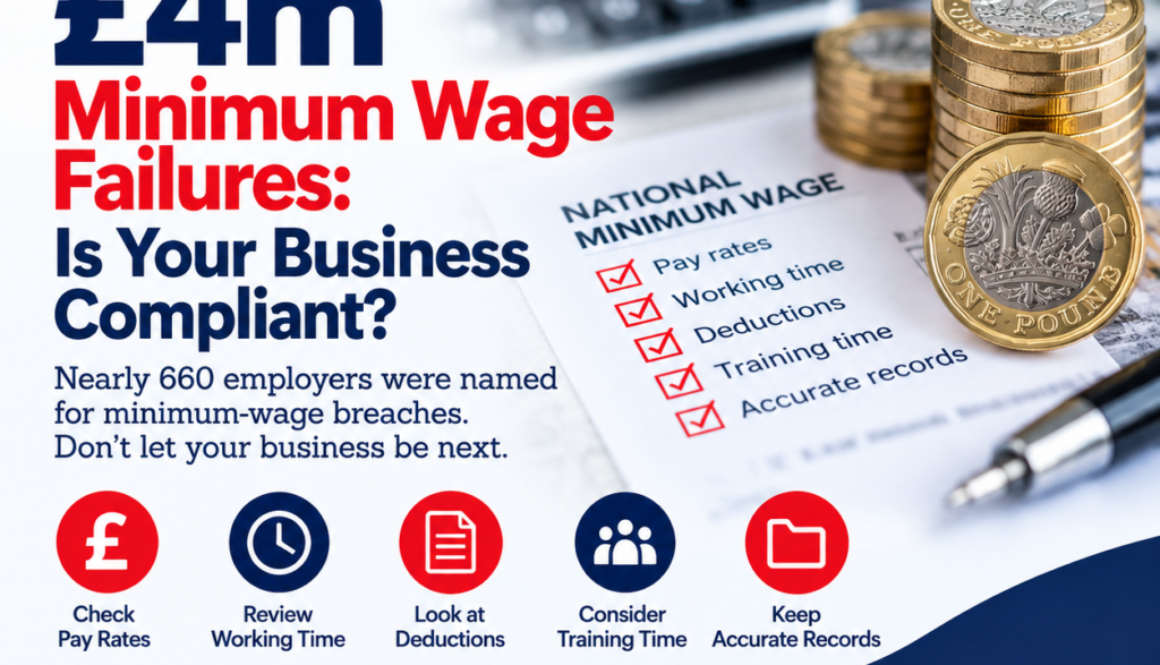
£4m Minimum Wage Failures: Is Your Business Compliant? | Consensus HR – Herts & Beds
|

|

Consensus HR | Hertfordshire, Bedfordshire & Cambridgeshire
The new Fair Work Agency (FWA) has begun its inspection activity, with employers being contacted about forthcoming visits and being told what employment documentation enforcement officers may wish to inspect.
For employers, this is another reminder of why HR compliance cannot simply be dealt with when something goes wrong.
The Fair Work Agency was established on 7 April 2026 under the Employment Rights Act 2025 and is responsible for enforcing a range of employment rights. Its current responsibilities include employment agency conduct, modern slavery and gangmasters licensing, with responsibility for National Minimum Wage enforcement due to transfer fully from HMRC from April 2027.
Employers may be selected for an inspection to assess whether they are complying with legislation falling within the FWA’s remit.
Importantly, an inspection does not necessarily mean that somebody has made a complaint.
Inspections may be prearranged or unannounced.
Where an inspection is arranged in advance, employers will usually receive an email explaining what documentation the FWA wishes to inspect and the deadline for providing it.
The documents requested will depend upon the organisation and the reason for the inspection. For example, an employment agency could be asked to provide workers’ contracts, Key Information Documents and terms of business with clients.
Employers should understand that an FWA inspection can involve considerably more than somebody simply asking to see a few HR documents.
Enforcement officers may examine documents, require individuals to produce or explain records, inspect business premises and inspect computers or other equipment used to process or store relevant information.
They may also require information to be provided, issue notices of underpayment, seize documents where authorised and potentially extend an investigation to relevant labour providers or users.
This makes good record keeping increasingly important. Employment documentation should not only be legally compliant – it needs to be accurate, current, organised and accessible.
This is an area employers should take particularly seriously.
Obstructing an enforcement officer or providing false documentation may constitute a criminal offence.
Refusing to provide information, preventing access to premises, failing to comply with instructions or hindering the removal of documents may result in enforcement action, potentially including prosecution, civil penalties, criminal investigation or Labour Market Enforcement Orders.
The message for employers is straightforward: do not wait until an enforcement officer arrives before checking whether your HR records are in order.
At Consensus HR, we regularly talk about being proactive rather than reactive when managing people.
An FWA inspection is a good example of why.
Are our Contracts of Employment up to date?
Can we easily demonstrate that employees and workers have received the correct documentation?
Are our payroll and working-time records accurate and accessible?
Are National Minimum Wage requirements being correctly followed?
Are Right to Work records complete and stored correctly?
Are our HR policies and procedures current?
Do managers know what to do if an enforcement officer arrives at the business?
Could we confidently produce the information requested within a specified deadline?
If the answer to any of those questions is “I’m not sure”, now is the time to check.
It is not enough for HR documentation simply to exist somewhere on a computer.
Senior managers and those responsible for employees need to understand the organisation’s HR processes and know where relevant records are held.
Businesses should also have a clear process for dealing with an inspection. If an enforcement officer attends unexpectedly, employees and managers need to know who should be contacted internally and who is authorised to deal with the inspection.
A confused response can make an already challenging situation significantly harder.
The Fair Work Agency does not yet have the full range of enforcement responsibilities it is expected to have in the future.
That makes 2026 an important opportunity for employers to review their HR compliance before the enforcement landscape develops further.
At Consensus HR, we work with SMEs across Hertfordshire, Bedfordshire and Cambridgeshire, helping businesses ensure their employment documentation, HR policies and people-management processes are legally compliant and practically workable.
Our retained clients benefit from ongoing HR and Employment Law support, helping them remain proactive as legislation and employer responsibilities change.
If you are unsure whether your HR documentation would withstand scrutiny, we can undertake an HR review and identify areas that may need attention.
Consensus HR – Your Outsourced HR Department
Helping companies take the pain out of managing people through clear, commercial and compliant people management.
Website: www.consensushr.com
Main Office: 01438 576750
Email: [email protected]
Serving businesses throughout Hertfordshire, Bedfordshire and Cambridgeshire.
Ask Consensus HR for Support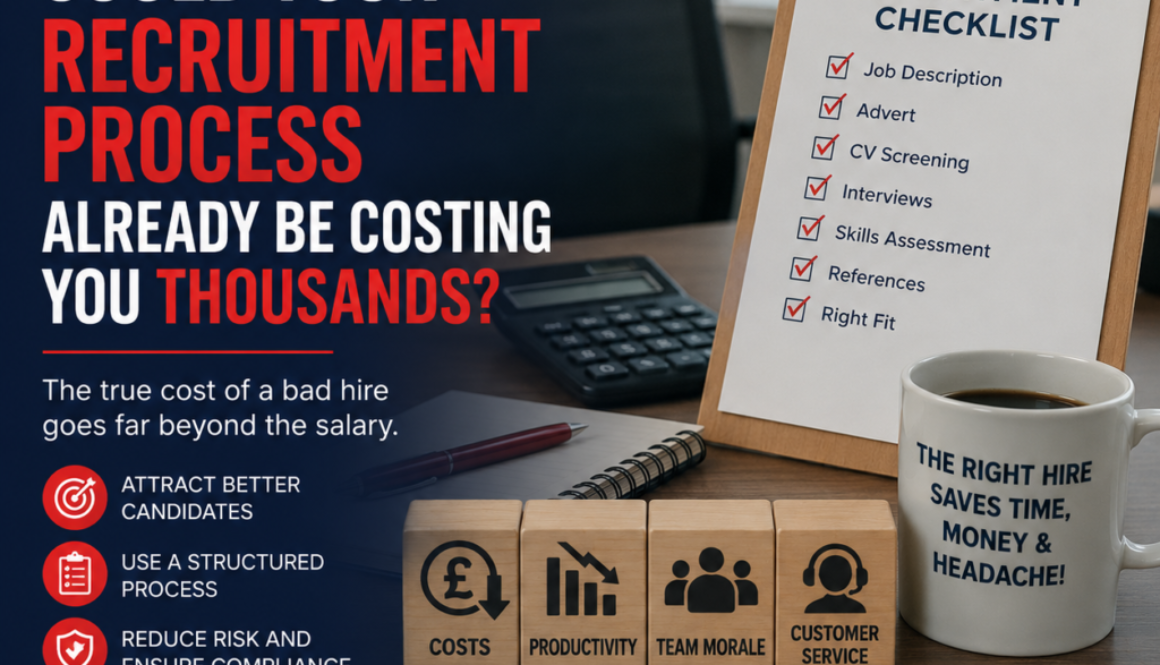
For many business owners, recruitment is seen as a necessary part of running a successful organisation. A vacancy arises, an advert is placed, interviews are held and hopefully the right person is appointed. Unfortunately, the reality is often very different.
At Consensus HR, we regularly meet businesses that believe they have a recruitment problem when, in fact, they have a recruitment process problem.
The cost of recruiting the wrong employee is rarely limited to recruitment agency fees or advertising costs. A poor recruitment decision can quickly result in thousands of pounds being lost through reduced productivity, management time, training costs, customer dissatisfaction, low team morale and, in some cases, expensive Employment Tribunal claims.
With significant changes to Employment Law continuing to reshape the way employers manage people, now is the ideal time for businesses to review how they recruit. A professional, structured recruitment process is no longer simply good practice—it is an essential investment in protecting your business.
Many employers understandably focus on filling a vacant position as quickly as possible. When workloads are increasing and teams are under pressure, speed often becomes the priority.
However, recruiting quickly without following a structured process can create problems that last far longer than the recruitment exercise itself.
Consider the hidden costs:
Research consistently shows that replacing an employee can cost many thousands of pounds, particularly when indirect costs are taken into account. For SMEs, one poor recruitment decision can have a significant financial impact.
Recruitment is often viewed as the employer assessing the candidate. In reality, every interview is also an opportunity for the candidate to assess your business.
Professional applicants are looking for employers who demonstrate:
A poorly organised interview, unclear job description or inconsistent communication can discourage excellent candidates from accepting an offer.
The recruitment experience forms part of your employer brand. Businesses that invest in a positive candidate experience are far more likely to attract and retain high-quality employees.
One of the biggest mistakes we see at Consensus HR is recruitment based solely on instinct.
Many employers tell us:
“I just had a good feeling about them.”
Whilst experience and intuition certainly have a place, they should never replace objective assessment.
A structured recruitment process should include:
When every candidate is assessed against the same criteria, recruitment becomes fairer, more consistent and much easier to justify should your decision ever be challenged.
Interviews should never become casual conversations.
Instead, questions should encourage candidates to demonstrate how they have dealt with real workplace situations.
For example:
Instead of asking:
“Are you good at dealing with customers?”
Ask:
“Tell me about a time when you dealt with a particularly difficult customer. What was the situation, what action did you take and what was the outcome?”
Behavioural questions provide far better evidence than hypothetical answers.
They also allow employers to compare candidates more objectively.
Recruitment documentation is often overlooked.
Many employers keep only the successful applicant’s paperwork, discarding interview notes for unsuccessful candidates.
This can be a costly mistake.
Good recruitment records help demonstrate:
If a recruitment decision is challenged, contemporaneous interview notes often become one of the most valuable pieces of evidence available.
The employment landscape continues to change.
As further provisions of the Employment Rights Act 2025 are introduced over the coming months and years, businesses will need to demonstrate even greater consistency throughout the employment lifecycle.
Employers should already be reviewing:
Businesses that prepare early are far better placed than those waiting until legislation changes before taking action.
At Consensus HR, we understand that recruitment is about much more than finding someone to fill a vacancy.
It is about helping businesses recruit the right person whilst reducing employment risk.
We support organisations across Hertfordshire, Bedfordshire and beyond with:
✔ Recruitment strategy
✔ Job Descriptions
✔ Person Specifications
✔ Interview question banks
✔ Interview scoring sheets
✔ Recruitment training
✔ Employment Contracts
✔ Employee Handbooks
✔ Onboarding documentation
✔ Three-Month Probationary Workbooks
✔ Manager development
✔ Ongoing HR advice through our retained HR service
Rather than reacting to problems, we help employers prevent them.
“Throughout my career, I have interviewed and recruited hundreds of employees across hospitality, retail, local government, manufacturing and professional services. One thing has remained consistent: businesses that invest time in getting recruitment right almost always experience lower staff turnover, stronger employee engagement and better business performance. Recruitment should never simply be about filling today’s vacancy; it should be about building tomorrow’s business. At Consensus HR, we work with our clients to ensure every stage of the recruitment process is professional, compliant and designed to identify the very best people for their organisation.”
Matthew Chilcott
Owner – Consensus HR
Chartered FCIPD | ACEL | BA (Hons)
Are you confident your recruitment process would stand up to scrutiny?
Would your managers know exactly how to conduct a compliant interview?
Are your contracts, onboarding documents and probation procedures up to date?
If the answer to any of these questions is no, now is the ideal time to review your recruitment process.
At Consensus HR, we offer a complimentary HR review to help identify potential risks before they become expensive problems.
Consensus HR – Helping Businesses Take the Pain Out of Managing People
📞 Telephone: 01438 576750
📱 Mobile: 07747 7789279
📧 Email: [email protected]
🌐 Website: https://www.consensushr.com
📚 Latest HR Blogs:
https://www.consensushr.com/blogs-hr/
Stay up to date with the latest Employment Law developments, HR best practice, management advice and practical guidance for SMEs.
For further information on any of the HR subjects we provide, please click the heading below:



Consensus HR receives Award of Excellence 2026
In today’s competitive and fast-moving business environment, effective people management plays a vital role in long-term success. As organisations grow, the demands of human resources and employment law can become increasingly complex and time-consuming. Consensus HR has positioned itself as a reliable partner for businesses seeking professional, practical, and compliant HR support, enabling them to focus on growth while remaining fully aligned with UK legislation.
Consensus HR provides outsourced human resources and employment law support designed to meet the needs of businesses across a wide range of sectors. By outsourcing HR functions, companies can remove the pressure of managing policies, procedures, and employee issues internally, while still benefiting from expert guidance. This approach not only saves time and resources but also ensures that HR responsibilities are handled accurately and consistently by experienced professionals.
Here at E2 Media we have proudly unveiled the highly anticipated 2026 Awards of Excellence, celebrating remarkable achievements across a wide range of industries. Among this year’s standout winners is Consensus HR. Their unwavering dedication to delivering exceptional service sets them apart, earning the respect and admiration of both industry peers and loyal clients. This recognition not only reflects Consensus HR’s ongoing commitment to excellence but also underscores their consistent efforts to provide a seamless, positive and memorable experience for every client. At E2 Media, we believe in championing organisations that bring fresh, innovative ideas to their markets. They need not be the largest, but they must strive to offer something truly distinctive—above all delivering an outstanding product or service. Consensus HR embodies all of these qualities, making them a truly deserving recipient of this year’s award.
A key advantage of working with Consensus HR is their tailored approach. Rather than offering one-size-fits-all solutions, the team takes time to understand each client’s individual challenges, goals, and workplace culture. This allows them to deliver personalised HR strategies that support both employers and employees. From managing employee relations and handling disciplinary matters to supporting recruitment and performance management, Consensus HR provides practical advice that fits the realities of modern workplaces.
Employment law in the UK is constantly evolving, making compliance a significant concern for many businesses. Keeping up with legislative changes can be difficult without dedicated expertise, and mistakes can be costly. Consensus HR offers specialist employment law support to help businesses remain compliant and confident. Their guidance covers essential areas such as drafting and reviewing employment contracts, developing legally compliant policies, and advising on best practice in line with current legislation.
By staying up to date with changes in UK employment law, Consensus HR helps businesses reduce risk and avoid potential disputes. Their proactive approach ensures that clients are informed of relevant updates and supported in implementing changes effectively. This allows business owners and managers to make informed decisions, knowing their HR practices meet legal requirements.
Beyond compliance, Consensus HR aims to help businesses thrive by promoting positive and productive working environments. Strong HR practices contribute to improved employee engagement, clearer communication, and better overall performance. With professional support readily available, businesses can address issues early, build stronger teams, and create workplaces where employees feel supported and valued. By combining tailored support with a strong focus on compliance, Consensus HR enables organisations to operate with confidence, efficiency, and peace of mind—allowing them to focus on what they do best while their HR is in safe hands. For more information visit www.consensushr.com
For further information on any of the HR subjects we provide, please click the heading below:

Putting up Christmas decorations in the office lifts morale — but employers must meet their health & safety responsibilities under the Health and Safety at Work etc. Act 1974.
Step ladders, lights and electrical decorations must be used safely.
PAT-tested lights reduce the risk of electrical faults.
Walkways must stay clear to prevent slips or trips.
Real Christmas trees require proper care (fire risk if they dry out).
Staff must not climb on furniture to hang decorations.
A festive workspace is great — but safety must come first.
At Consensus HR, we help employers manage workplace risks, ensuring celebrations don’t compromise safety.
Comment from Matthew Chilcott – Owner:
“Christmas decorations create a wonderful atmosphere — but keeping your team safe is essential. A few simple checks protect everyone.”
👉 Need practical HR and H&S advice this Christmas? Visit: https://www.consensushr.com
🎄 Christmas Message from Consensus HR:
Wishing all our clients, contacts and community a Merry Christmas & a Happy New Year 2026!
📲 Connect with us:
LinkedIn: https://www.linkedin.com/company/consensushr
Facebook: https://www.facebook.com/consensushr
X/Twitter: https://twitter.com/consensushr
For further information on any of the HR subjects we provide, please click the heading below:

Did you know that Statutory Sick Pay (SSP) in the UK must be paid to eligible employees from the 4th consecutive day of sickness absence? Many SMEs mistakenly believe it starts immediately or after a week, but not following the correct process can lead to legal risks.
SSP is currently £116.75 per week (2025–26 rates to be confirmed), and employers must have clear absence and sickness procedures in place.
Matthew Chilcott, FCIPD, says:
“A clear absence management policy, backed by proper documentation such as return-to-work forms, protects both the employer and employee. We support SMEs in creating compliant policies that reduce absence-related disputes.”
👉 Explore our HR Policies & Procedures Support
📱 Follow us on:
For further information on any of the HR subjects we provide, please click the heading below:
For SMEs navigating the complex world of employment regulations, contracts, performance issues, and people management—without any dedicated HR support—it can feel overwhelming. That’s where Consensus HR steps in as your trusted local partner, delivering expert, outsourced HR and employment law services tailored to your business’s size and needs.
Based in Stevenage and serving Hertfordshire, Bedfordshire, Cambridge, Luton, Milton Keynes, and beyond, Consensus HR provides:
Fully outsourced HR support, or small-scale solutions as needed
Employment contracts, handbooks, and compliant HR policies
Guidance on performance, disciplinary, grievance, absence, and mental health management
Employment law advice aligned with the latest UK legislation
A local, personal approach, not a distant call centre
👉 Learn more at www.consensushr.com
Matthew Chilcott, Chartered FCIPD and Owner of Consensus HR (with an advanced postgraduate qualification in Employment Law), draws on a wealth of experience across hospitality, water services, and regional HR consultancy roles.
From his recent blog post HR & Line Management Is Not Easy: Myths vs Reality, Matthew explains:
“HR? Line management? That’s easy. Anyone can do it.”—it’s a dangerously misleading mindset. Proper HR is about knowing employment law, balancing empathy with performance, documenting everything, leading by example, and planning ahead.
At Consensus HR, we help SMEs replace guesswork with confidence—creating compliant handbooks, training managers, safeguarding mental health, and preventing disputes before they happen.”
Consensus HR was honoured as SME-Focused HR Consultancy of the Year 2025 – Home Counties, recognising their exceptional service to small and medium-sized businesses.
Read more: Corporate Vision Award Winners
Stay updated and connect across all major platforms:
Website: www.consensushr.com
LinkedIn: Consensus HR
Facebook: Consensus HR
Twitter/X: @ConsensusHR
| Benefit | What You Gain |
|---|---|
| Legal Compliance | Avoid costly tribunals with expert guidance |
| Scalable Support | Tailored services from one-off projects to full HR outsourcing |
| Experienced Leadership | Backed by a seasoned HR professional with deep operational experience |
| Award-Winning Service | Recognised for excellence in SME-focused HR |
| Accessible & Local | Direct, friendly support without jargon or call-centre frustrations |
If your business is operating without any HR support right now, Consensus HR offers a lifeline—helping you stay compliant, reduce risks, and build a confident, people-focused workplace.
👉 Visit Consensus HR today to request a free HR check-up or consultation. You’ll get clear advice, expert support, and peace of mind—letting you focus on what you do best: growing your business.
For further information on any of the HR subjects we provide, please click the heading below:
By Matthew Pinto-Chilcott, Chartered FCIPD, Owner of Consensus HR
www.consensushr.com
Over my years in operations and HR, I’ve lost count of how many times I’ve heard:
“HR? Line management? That’s easy. Anyone can do it.”
I’ve been told:
“Give somebody a set of keys and they’re a manager!”
“HR is easy — all they do is hire and fire.”
“He can manage — he’s here every day, never been sick and works hard.”
“Just fire them!”
“They’re thick.”
“They’re lazy.”
“They’re so slow.”
“Performance reviews are a waste of time!”
“I’ll trial them before I give them a contract.”
These throwaway comments reveal a worrying truth — that many still underestimate what’s actually involved in managing people and running HR effectively.
I started my career in hospitality, managing large, diverse teams in bars, restaurants, hotels, and retail sites at Heathrow, Gatwick, and motorway services. Later, I moved into operations and HR leadership roles across the water industry and other sectors. That experience taught me a vital lesson:
Good management and HR is not about having keys to the building, working long hours, or “telling people what to do”.
It’s about:
Understanding employment law — knowing what you can and cannot do.
Balancing empathy with performance — supporting people while holding them accountable.
Documenting everything properly — from contracts to performance notes, so you’re protected legally.
Leading by example — setting a culture, not just a rota.
Planning ahead — from workforce development to mental health support.
The casual “just fire them” approach often leads straight to a costly employment tribunal.
Not giving someone a contract because you “want to trial them” is illegal in the UK — every employee has a legal right to written terms from day one.
Dismissing performance reviews as “a waste of time” means missing the single biggest opportunity to motivate staff, set clear goals, and prevent underperformance before it becomes a major issue.
And labelling someone “lazy” or “slow” without investigating why is a sure-fire way to damage morale, invite discrimination claims, and lose good people.
At Consensus HR, we work with SMEs across all sectors to replace guesswork with confidence. We:
Create legally compliant contracts, handbooks, and policies.
Train managers to handle disciplinaries, grievances, and absence the right way.
Implement performance management processes that actually work.
Support mental health and wellbeing strategies.
Keep you up-to-date with ever-changing employment law.
The result? Fewer surprises, fewer disputes, and stronger teams.
I’ve seen both sides — the rushed “anyone can manage” approach, and the strategic, well-planned way.
Only one consistently builds teams that perform and businesses that thrive.
HR & line management are not easy. They are skills — just like finance, marketing, or engineering — and they require training, planning, and professionalism.
So next time someone says “HR is easy”, I’ll politely remind them:
It’s only easy if you’re not doing it properly.
📞 Need help managing people, legally and effectively?
Contact Consensus HR today — www.consensushr.com
Follow us on:
For further information on any of the HR subjects we provide, please click the heading below:

The Low Pay Commission (LPC), the independent body which advises the Government on the levels of the National Minimum Wage (NMW), including the National Living Wage (NLW), has launched a call for evidence to inform its advice to the Government on the minimum wage in 2025 and beyond.
With full details available on the GOV.UK website, it is seeking input to shape the recommendations which it will make to the Government this autumn, on minimum wage rates to apply from April next year.
The deadline for submitting evidence is 7 June 2024.
The Department for Business and Trade (DBT) has published a new remit for the LPC which can be found here.
This asks the Commission to recommend an NLW rate for April 2025 “to maintain the bite at two-thirds of median earnings and protect progress made to end low hourly pay for this group, without recommending any further revisions to the age threshold”.
The LPC estimates that the rate required to meet this aim is within the range of £11.61 and £12.18, with a central estimate of £11.89.
The Government also asks the LPC to monitor and evaluate the levels of each of the different NMW rates (under-18 and 18–20 age groups and apprentice rate) and make recommendations on the increases it believes should apply from April 2025, such that the rates are set as high as possible without damaging the employment prospects of each group.
The TUC has criticised the Government for its decision to “tie the hands” of the LPC.
General Secretary, Paul Nowak, said: “Keeping the minimum wage at two-thirds of median earnings will deliver a paltry increase of just 15 pence next year — based on the latest forecasts. Ministers should be instructing the LPC to aim for 75% of median pay. This would help deliver a £15 an hour minimum wage and make work pay for millions.”


Matthew Chilcott, FCIPD, ACEL, Owner of Consensus HR comments: “With the most recent pay rate increases happening at the beginning of this month with on average £1 per hour extra, it is interesting to see that that the low pay commission are starting to work on the rates for 2025. This article from HR inform gives some useful links to Government websites where further information can be found. We have written a number of previous blogs on minimum wage which can be found by clicking on the relevant title below:


More than 500 businesses, including Greggs and Harrods, failed to pay some of their employees the minimum wage, according to a list released by the Department for Business and Trade. The analysis, which covers breaches between 2015 and 2023, shows that recruitment agency Staffline topped the list for failing to pay 36,767 workers correctly, while Estée Lauder failed to pay £894,980 to almost 6,000 workers. The report shows that 524 employers have repaid more than 172,000 workers almost £16m, plus an additional penalty, for breaches in paying the statutory national minimum wage. Kevin Hollinrake, the minister for enterprise, markets and small businesses, said: “Employees deserve to get paid properly for the hard work they put in.” Caroline Harwood, an employer tax partner at BDO, said: “It’s always a bit of a shock to see so many well-known names appearing on HMRC’s list of employers who have been found to be in breach of national minimum wage rules.”
Matthew Chilcott, FCIPD, ACEL, Owner of Consensus HR comments: “This never ceases to amaze me, the amount of companies that fail to pay the minimum wage considering our wages are one of the main things we all work for. However, it can also be easier said than done and hence why, the importance of ensuring yearly salary reviews take place, to give businesses the opportunity to make sure all members of the team are paid adequately.

Generally wage increases happen in April each year and is publicised extensively by the Government so as to ensure that all businesses have the information to make any changes needed. The Government has announced the rates of the National Living Wage (NLW) and National Minimum Wage (NMW) which will come into force from April 2024. In doing so, it has accepted in full the recommendations of the Low Pay Commission.
|
NMW Rate |
Increase in pence |
Percentage increase |
|
|
National Living Wage (21 and over) |
£ 11.44 |
£ 1.02 |
9.8% |
|
18-20 Year Old Rate |
£ 8.60 |
£ 1.11 |
14.8% |
|
16-17 Year Old Rate |
£ 6.40 |
£ 1.12 |
21.2% |
|
Apprentice Rate |
£ 6.40 |
£ 1.12 |
21.2% |
|
Accommodation Offset |
£ 9.99 |
£ 0.89 |
9.8% |
For further information on any of the HR subjects we provide, please click the heading below:
According to the latest Labour Market Outlook, produced by the Chartered Institute of Personnel and Development (CIPD), employers’ basic pay increase expectations over the next 12 months have fallen for the first time since spring 2020.
Having held steady at 5% for more than a year, UK employers expected basic pay increases for the year ahead have fallen to 4%, the CIPD has reported.
Its report also shows that fewer employers expect their workforce to grow than in previous quarters. Overall, a third (33%) of employer’s plan to increase their total staff level over the next three months while 10% plan to decrease their overall staffing levels.
However, many employers (38%) continue to report hard-to-fill vacancies and one in five respondents (21%) expect significant problems filling roles over the next six months.
Senior Labour Market Economist for the CIPD, Jon Boys, said: “We’ve seen a sustained period of high wage growth in response to a tight labour market, and high inflation pushing up the cost-of-living. Pay growth has helped individuals but it leaves employers with a higher wage bill to cover.”
To see a sustained return to growth, he continued, there needs to be a real focus on boosting productivity by investing in workplace skills and technology.
If firms are planning to reduce base pay increases, Mr Boys suggested that it would be in their interest to highlight their wider benefits package and to improve job quality.
The Labour Market Outlook for Winter 2023–24 can be found here.
HRInform – 13th February 2024
Matthew Chilcott, FCIPD, ACEL, Owner of Consensus HR comments: “This article from the CIPD, our Chartered Institute has some very interesting statistic and emphasises the importance of business ensuring that their recruitment strategy for their business is correct and attracting / retaining the right talent. A Consensus HR, we work with companies to ensure that when they do recruit, they have all the correct tools in place to make it a success such as: Right advertising and marketing, correct recruitment strategy, writing of a Job Description, drafting of an applicable Contract of Employment, which they must have from day one of Employment. Access to a comprehensive HR Employee Handbook and state of the art IT system where they can gain access to all their / companies HR Policies and Procedures and records and book a holiday. Consensus HR help companies in all areas of Human Resources whilst making sure that our clients are never treated as a number and when they call us, we know straight away what they wish to discuss whilst providing a suitable best practice and Employment Law solution.”
HM Revenue and Customs (HMRC) has launched a consultation seeking views on calculating PAYE liabilities in cases of non-compliance for off-payroll working (IR35).
This technical consultation sets out the mechanism by which HMRC will be able to account for taxes already paid by individuals and their intermediary on income received from off-payroll working when recovering the tax due under PAYE from the employer.
It includes a draft Statutory Instrument (SI), the Income Tax (Pay As You Earn) (Amendment) Regulations 2024, and several items of draft guidance/
The draft SI contains detailed provisions to be introduced in the Income Tax (Pay As You Earn) Regulations 2003 to allow the PAYE liability that is recovered from the deemed employer to be reduced by amounts of tax already assessed and/or paid by the worker and their intermediary.
It also contains conditions under which it can apply, the mechanics of the recovery and the appeal rights associated with it.
People who work through their own intermediary (eg a personal service company (PSC)) are advised to consider this consultation as are medium and large-sized clients, public authorities, agencies, partnerships and individuals who engage people who work through their own intermediaries.
HMRC suggests that it will also be of interest to HR managers and those who deal with recruitment processes and payroll.
Full details, including the various drafts, can be found on the GOV.UK website and the deadline for submitting comments is 22 February 2024.
HRInform – 26-Jan-24
Matthew Chilcott FCIPD, ACEL, Owner of Consensus HR comments: “It is good to see that the HMRC are asking for comments in relations to payments in relation to IR35 as this has been a rather complicated system since its introduction. The IR35 – off payroll working rules make sure that a worker (sometimes known as a contractor) pays broadly the same Income Tax and National Insurance as an employee would.
The rules apply if the worker who provides services to a client through their own intermediary would have been an employee if they were providing their services directly to that client.
The Gov.UK website has detailed information in relation to this and who the rules apply to etc.
At Consensus HR, we work with a payroll company that ensures all our clients not only have the best HR & Employment Law services but also payroll support when needed.
For further information on any of the HR subjects we provide, please click the heading below:

Comment from Matthew Chilcott – Owner, Consensus HR
“The arrival of the Fair Work Agency is another significant change for UK employers and reinforces something we have always encouraged our clients to do – manage HR proactively rather than waiting for a problem.
An employer may believe everything is fine because nobody has complained, but an inspection does not necessarily need to follow a complaint.
If somebody arrived at your business and asked to see your employment documentation, contracts and relevant records, how quickly could you produce them and how confident would you be that everything was legally compliant and up to date?
That is the question I would encourage every SME owner and manager to ask.
Good HR is not about producing paperwork for the sake of paperwork. It is about having clear, commercial and compliant people-management processes that you can demonstrate when required.”
Matthew Chilcott – Owner, FCIPD, ACEL, BA (Hons)