
Could Your Recruitment Process Already Be Costing You Thousands? | Consensus HR in Herts & Beds
The Hidden Cost of Poor Recruitment and Why Getting It Right First Time Matters More Than Ever
For many business owners, recruitment is seen as a necessary part of running a successful organisation. A vacancy arises, an advert is placed, interviews are held and hopefully the right person is appointed. Unfortunately, the reality is often very different.
At Consensus HR, we regularly meet businesses that believe they have a recruitment problem when, in fact, they have a recruitment process problem.
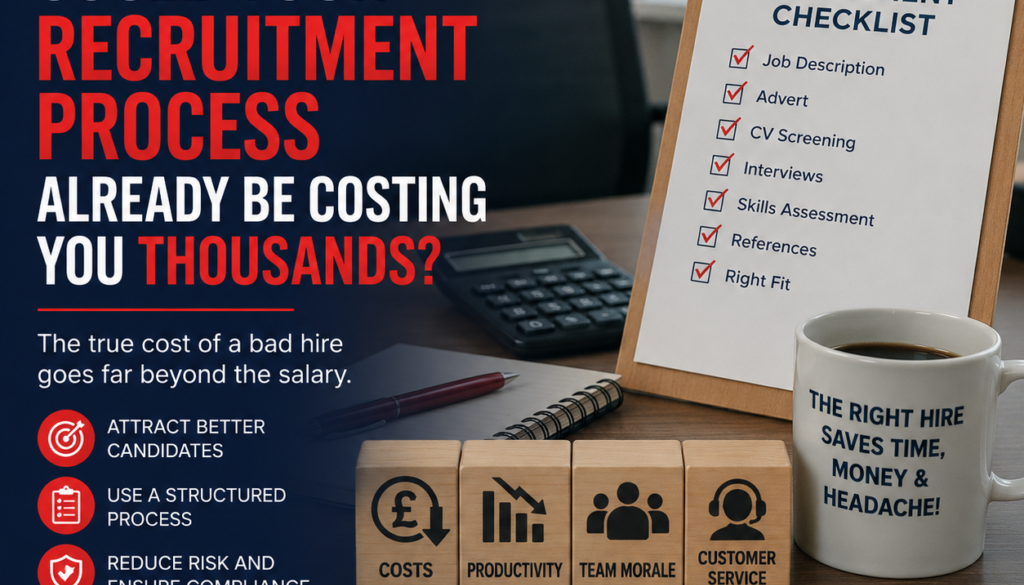
The cost of recruiting the wrong employee is rarely limited to recruitment agency fees or advertising costs. A poor recruitment decision can quickly result in thousands of pounds being lost through reduced productivity, management time, training costs, customer dissatisfaction, low team morale and, in some cases, expensive Employment Tribunal claims.
With significant changes to Employment Law continuing to reshape the way employers manage people, now is the ideal time for businesses to review how they recruit. A professional, structured recruitment process is no longer simply good practice—it is an essential investment in protecting your business.
Recruitment Is More Than Filling a Vacancy
Many employers understandably focus on filling a vacant position as quickly as possible. When workloads are increasing and teams are under pressure, speed often becomes the priority.
However, recruiting quickly without following a structured process can create problems that last far longer than the recruitment exercise itself.
Consider the hidden costs:
- Advertising the vacancy.
- Time spent reviewing CVs.
- Managers conducting interviews.
- Induction and onboarding.
- Training.
- Reduced productivity whilst the new employee learns the role.
- Mistakes made through lack of experience.
- The impact on colleagues covering the workload.
- Lost customers if service standards fall.
- Having to recruit all over again if the employee leaves within the first few months.
Research consistently shows that replacing an employee can cost many thousands of pounds, particularly when indirect costs are taken into account. For SMEs, one poor recruitment decision can have a significant financial impact.
First Impressions Work Both Ways
Recruitment is often viewed as the employer assessing the candidate. In reality, every interview is also an opportunity for the candidate to assess your business.
Professional applicants are looking for employers who demonstrate:
- Organisation.
- Clear communication.
- Professionalism.
- Fairness.
- Transparency.
- Well-managed recruitment processes.
A poorly organised interview, unclear job description or inconsistent communication can discourage excellent candidates from accepting an offer.
The recruitment experience forms part of your employer brand. Businesses that invest in a positive candidate experience are far more likely to attract and retain high-quality employees.
Are You Recruiting on Evidence or Instinct?
One of the biggest mistakes we see at Consensus HR is recruitment based solely on instinct.
Many employers tell us:
“I just had a good feeling about them.”
Whilst experience and intuition certainly have a place, they should never replace objective assessment.
A structured recruitment process should include:
- A detailed Job Description.
- A Person Specification.
- Consistent interview questions.
- Competency-based questioning.
- Objective scoring.
- Interview notes.
- A clear decision-making process.
When every candidate is assessed against the same criteria, recruitment becomes fairer, more consistent and much easier to justify should your decision ever be challenged.
The Importance of Asking the Right Questions
Interviews should never become casual conversations.
Instead, questions should encourage candidates to demonstrate how they have dealt with real workplace situations.
For example:
Instead of asking:
“Are you good at dealing with customers?”
Ask:
“Tell me about a time when you dealt with a particularly difficult customer. What was the situation, what action did you take and what was the outcome?”
Behavioural questions provide far better evidence than hypothetical answers.
They also allow employers to compare candidates more objectively.
Documentation Protects Your Business
Recruitment documentation is often overlooked.
Many employers keep only the successful applicant’s paperwork, discarding interview notes for unsuccessful candidates.
This can be a costly mistake.
Good recruitment records help demonstrate:
- Fair selection decisions.
- Consistency.
- Compliance with the Equality Act 2010.
- Objective decision-making.
- Transparency.
If a recruitment decision is challenged, contemporaneous interview notes often become one of the most valuable pieces of evidence available.
Employment Law Continues to Evolve
The employment landscape continues to change.
As further provisions of the Employment Rights Act 2025 are introduced over the coming months and years, businesses will need to demonstrate even greater consistency throughout the employment lifecycle.
Employers should already be reviewing:
- Recruitment procedures.
- Employment Contracts.
- Employee Handbooks.
- Probationary processes.
- Management training.
- Record keeping.
- Performance management.
Businesses that prepare early are far better placed than those waiting until legislation changes before taking action.
Why Work With Consensus HR?
At Consensus HR, we understand that recruitment is about much more than finding someone to fill a vacancy.
It is about helping businesses recruit the right person whilst reducing employment risk.
We support organisations across Hertfordshire, Bedfordshire and beyond with:
✔ Recruitment strategy
✔ Job Descriptions
✔ Person Specifications
✔ Interview question banks
✔ Interview scoring sheets
✔ Recruitment training
✔ Employment Contracts
✔ Employee Handbooks
✔ Onboarding documentation
✔ Three-Month Probationary Workbooks
✔ Manager development
✔ Ongoing HR advice through our retained HR service
Rather than reacting to problems, we help employers prevent them.
Matthew Chilcott’s Comment
“Throughout my career, I have interviewed and recruited hundreds of employees across hospitality, retail, local government, manufacturing and professional services. One thing has remained consistent: businesses that invest time in getting recruitment right almost always experience lower staff turnover, stronger employee engagement and better business performance. Recruitment should never simply be about filling today’s vacancy; it should be about building tomorrow’s business. At Consensus HR, we work with our clients to ensure every stage of the recruitment process is professional, compliant and designed to identify the very best people for their organisation.”
Matthew Chilcott
Owner – Consensus HR
Chartered FCIPD | ACEL | BA (Hons)
Complimentary HR Review
Are you confident your recruitment process would stand up to scrutiny?
Would your managers know exactly how to conduct a compliant interview?
Are your contracts, onboarding documents and probation procedures up to date?
If the answer to any of these questions is no, now is the ideal time to review your recruitment process.
At Consensus HR, we offer a complimentary HR review to help identify potential risks before they become expensive problems.
Contact Consensus HR Today
Consensus HR – Helping Businesses Take the Pain Out of Managing People
📞 Telephone: 01438 576750
📱 Mobile: 07747 7789279
📧 Email: [email protected]
🌐 Website: https://www.consensushr.com
📚 Latest HR Blogs:
https://www.consensushr.com/blogs-hr/
Follow Consensus HR
- LinkedIn: https://www.linkedin.com/company/consensus-hr
- Facebook: https://www.facebook.com/ConsensusHR
- X: https://x.com/ConsensusHR
- Instagram: https://www.instagram.com/consensushr
- YouTube: https://www.youtube.com/@ConsensusHR
Stay up to date with the latest Employment Law developments, HR best practice, management advice and practical guidance for SMEs.
Your Outsourced Human Resources (HR) Department.
For further information on any of the HR subjects we provide, please click the heading below: