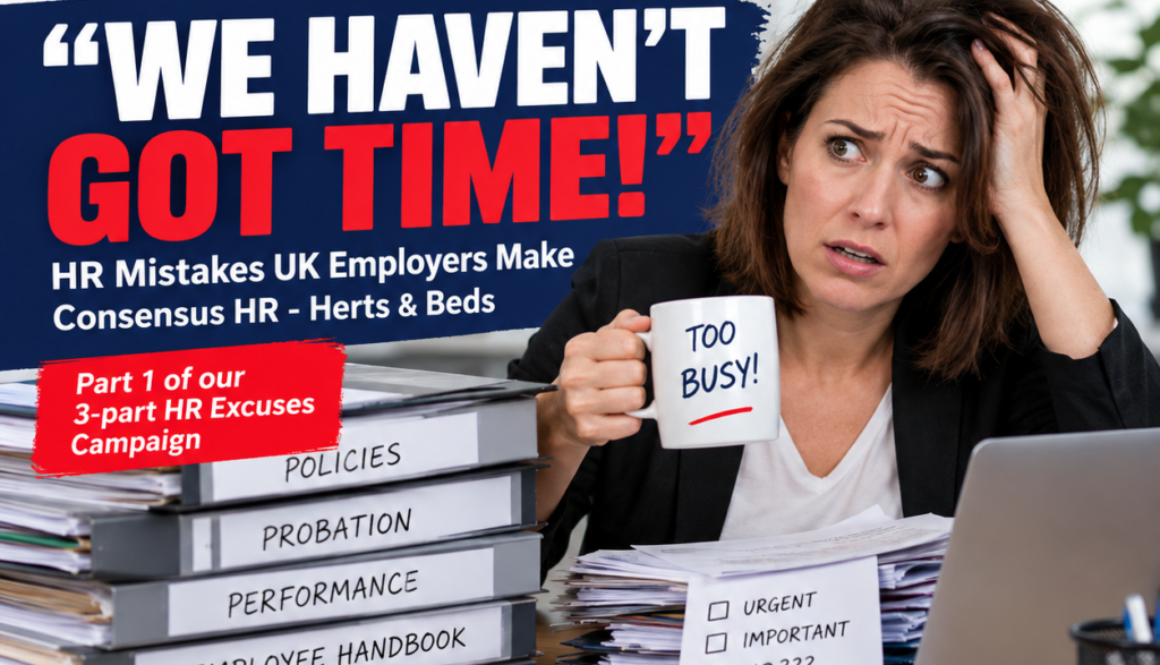
For the last three Thursdays, Consensus HR has been tackling some of the excuses businesses give for putting off good HR practice.
We finish our campaign with three areas that demonstrate exactly why our approach to HR is proactive rather than reactive.
Excuse 7: “We’ll Do the Right to Work Check Later”
Our answer: Don’t.
Employers have important legal responsibilities when checking an individual’s Right to Work in the UK. The prescribed check should be carried out before employment begins if the employer wishes to establish the relevant statutory excuse against liability for a civil penalty. It must also be completed and recorded correctly.
What could happen if you don’t? Current Government guidance provides for civil penalties of up to £60,000 per illegal worker in relevant circumstances. More serious consequences can arise in cases involving knowingly employing an illegal worker or having reasonable cause to believe somebody does not have the right to work.
“We’ll do it next week” could be an extraordinarily expensive sentence.
Excuse 8: “We’re Only an Office — Nothing Dangerous Happens Here”
Our answer: Health and safety is not just for factories, warehouses and construction sites.
Employers have responsibilities to assess and manage workplace risks. The nature of those risks will vary according to the organisation. An office is unlikely to have the same risks as a manufacturing plant, but that does not mean there are no risks to consider.
The HSE approach to risk assessment involves identifying hazards, deciding who might be harmed and evaluating what needs to be done to control the risks.
What could happen if you don’t? The question often comes after an incident: “Why wasn’t this risk identified?” That is not when an employer wants to start thinking about risk assessment.
Excuse 9: “We’ll Update the Employee Handbook When We Need To”
Our answer: The time to discover your policies are out of date is not when you are trying to use them.
Employment law changes. Government guidance changes. Your workforce changes. Technology changes. Working practices change. And your business changes.
Employee Handbooks and HR policies therefore need appropriate review. For Consensus HR retained clients with our relevant handbook service, keeping HR documentation under review is an important part of the support we provide.
We also encourage businesses to ensure employees can access current policies and that appropriate records are maintained when significant updates are communicated.
And finally… “Nothing Has Ever Gone Wrong Before”
Our answer: That doesn’t mean nothing will.
Businesses insure their premises before a fire. They back up computer systems before losing data. They manage cash flow before the bank account is empty. HR should be approached in exactly the same way.
Waiting for an Employment Tribunal claim, grievance, discrimination allegation, serious absence issue or major employee dispute before putting appropriate HR processes in place is the definition of reactive HR.
At Consensus HR, we believe in doing the opposite.
Comment from Matthew Chilcott — Owner, Consensus HR
“Throughout this three-week campaign, there has been one common theme behind every excuse — ‘we’ll deal with it when we need to’. My experience throughout my HR career has taught me that this is exactly the wrong way around.
The best HR work often happens quietly in the background: contracts are correct, policies are current, managers know what to do, probation reviews happen, conversations are documented and advice is taken before decisions are made.
You may never know exactly which problem that work prevented — and that is the point. At Consensus HR, we want our clients spending their time running and growing their businesses, not firefighting people problems that could have been prevented.”
Matthew Chilcott — Owner, FCIPD, ACEL, BA (Hons)
From excuses to action
Across our three-week campaign we have heard: “We haven’t got time.” “I’ve already told them.” “We’ll do the paperwork later.” “We’re only a small business.” “Everyone knows the rules.” “Can’t we just sack them?” “We’ll do the check later.” “We’re only an office.” “We’ll update it when we need it.” And finally: “Nothing has ever gone wrong before.”
Our response? Don’t wait for something to go wrong before finding out whether your HR is right.
Book a complimentary HR review
Consensus HR supports SMEs across Hertfordshire, Bedfordshire and Cambridgeshire with practical HR and Employment Law support designed to prevent people problems.
Last Thursday, we launched our three-part campaign looking at the HR excuses that can come back to haunt employers.
This week we tackle another three: “We’re only a small business.” “Everyone knows the company rules.” And the particularly dangerous: “Can’t we just sack them?”
Small businesses need practical HR — not unnecessary bureaucracy. But practical does not mean ignoring employment law or abandoning fair processes.
Excuse 4: “We’re Only a Small Business — Surely All This Doesn’t Apply to Us?”
Our answer: Being small is not a general exemption from employment law.
The size and administrative resources of an employer can be relevant in certain circumstances, but SMEs still need to manage employees fairly, consistently and lawfully.
In fact, poor HR can have a disproportionately large impact on a smaller organisation.
What could happen if you don’t? One difficult employee situation can consume hours of senior management time. Instead of focusing on customers, sales, operations, cash flow and growth, managers can become absorbed by grievances, investigations, disciplinary meetings, correspondence, sickness issues and potentially legal proceedings.
For an SME, prevention is generally far cheaper than cure.
Excuse 5: “Everyone Knows the Company Rules”
Our answer: Can you demonstrate that?
Where are your policies? When were employees given them? Can they access the current Employee Handbook? When something changes, how do employees know?
Having a beautifully written Employee Handbook sitting in a manager’s drawer is of little practical value. Employees should know where relevant policies can be found and employers should keep appropriate records showing that important information has been communicated.
For businesses using HR systems such as Breathe HR, keeping current documents accessible electronically can make this considerably easier.
What could happen if you don’t? Imagine trying to discipline an employee for breaching a company rule. The employee says, “I’ve never seen that policy.” The manager says, “Everyone knows it.” HR asks, “When was it given to them?” Silence.
Excuse 6: “Can’t We Just Sack Them?”
Our answer: Sometimes there may ultimately be a fair reason for dismissal — but process matters.
Depending on the circumstances, an appropriate process could involve establishing the facts, carrying out an investigation, informing the employee of the concerns, allowing them to respond, considering their explanation, following the relevant procedure, considering alternatives or mitigation and reaching a reasonable decision based on the evidence.
The Acas Code of Practice is particularly important in disciplinary and grievance situations.
What could happen if you don’t? An employer can begin with a genuine management concern and weaken its position through a flawed process. Where the Acas Code applies, an Employment Tribunal can adjust compensation by up to 25% for an unreasonable failure to comply with it.
Don’t decide the outcome and then try to create the process afterwards.
Comment from Matthew Chilcott — Owner, Consensus HR
“SME owners regularly tell me they don’t want HR to become corporate or bureaucratic — and I agree with them. Good HR for an SME should be practical and proportionate.
But there is an enormous difference between keeping a process straightforward and not following a process at all. When somebody says, ‘Can’t we just sack them?’, my job is to understand what has happened, identify the risks and help the business take the appropriate next steps.
Sometimes slowing a manager down and getting the process right can prevent months of unnecessary problems afterwards. Good HR doesn’t stop managers managing. It helps managers manage properly.”
Matthew Chilcott — Owner, FCIPD, ACEL, BA (Hons)
Next Thursday — the final part
Next week we tackle: “We’ll do the Right to Work check later.” “It’s only an office — we don’t really need Health & Safety.” And perhaps the biggest HR excuse of all: “Nothing has ever gone wrong before.”
Need practical HR support?
Consensus HR supports SMEs across Hertfordshire, Bedfordshire and Cambridgeshire with practical, proactive HR and Employment Law support.
“We pay everyone above minimum wage, so we’re fine.”
Are you sure?
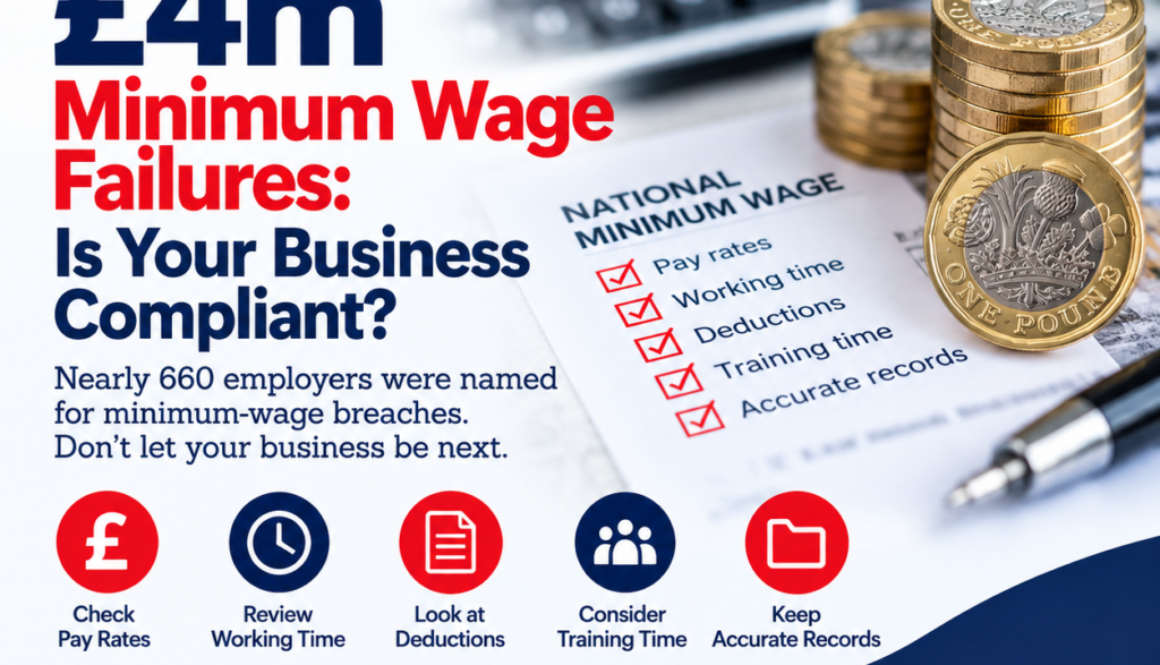
On 3 September 2026, the Government announced that nearly 660 employers had been named for failing to pay workers the National Minimum Wage. Around £4 million was repaid to more than 27,000 workers, while penalties issued to the employers involved totalled approximately £7 million. Read the Government announcement.
Minimum Wage compliance is not always as simple as looking at somebody’s hourly rate.
“We pay above minimum wage” isn’t the end of the conversation
An employee’s headline hourly rate may appear perfectly compliant. However, employers also need to understand what counts as working time and whether particular deductions or employment practices affect minimum-wage calculations.
Problems can arise around areas such as:
Working time
Training
Deductions
Uniform requirements
Unpaid additional time
Poor time records
Something that looks like a relatively minor administrative practice can potentially create a much larger compliance problem when multiplied across several employees and a significant period of time.
What happens if an employer gets it wrong?
Where minimum-wage underpayment is established, an employer can be required to repay arrears to the affected worker.
There can also be a financial penalty of up to 200% of the minimum-wage arrears, subject to a maximum of £20,000 per worker under the applicable enforcement rules. Government enforcement guidance.
And then there is something that can be even harder to repair: reputation.
The Government publicly names employers that meet the relevant criteria for minimum-wage breaches. For an SME that has spent years building its reputation with customers, employees and prospective recruits, appearing on such a list is unlikely to be welcome publicity.
Could your everyday working practices be creating a problem?
Ask yourself:
Do employees arrive early to prepare before their paid shift begins?
Are employees required to complete work-related activities after they have clocked out?
Do employees undertake compulsory training outside their normal paid hours?
Are deductions being made from wages?
Are employees required to buy items connected with their employment?
Are your working-time records accurate?
A payroll system can only process the information it receives. If the underlying HR and management practices are wrong, simply having professional payroll software will not necessarily solve the problem.
Five checks we would recommend employers make
Check current pay rates. Ensure everybody is receiving at least the correct statutory rate applicable to them.
Review actual working time. Look beyond contracted hours. What time are employees actually working?
Review deductions. Consider whether deductions or employment-related expenditure could affect minimum-wage calculations.
Check training arrangements. Workers must be paid correctly for working time, including relevant induction and compulsory work-related activities. ACAS induction guidance.
Keep accurate records. If challenged, could you demonstrate what hours somebody worked and what they were paid?
Comment from Matthew Chilcott – Owner, Consensus HR
“When employers hear about organisations being named for minimum-wage breaches, it can be very easy to think, ‘That would never happen to us because we pay above minimum wage.’
But the hourly rate shown on somebody’s Contract of Employment does not necessarily tell the whole story.
Employers need to understand what people are actually doing, the hours they are actually working and whether any deductions or workplace practices affect the calculation.
HR, management and payroll should work together. A small process error repeated across several employees can potentially become a much bigger and more expensive problem.”
Matthew Chilcott – Owner, Chartered FCIPD, ACEL, BA (Hons)
Proactive HR is cheaper than reactive HR
The latest Government figures provide another reminder of why employers should regularly review their HR practices rather than waiting for something to go wrong.
Nearly 660 employers named.
More than 27,000 workers affected.
Around £4 million repaid.
Approximately £7 million in penalties.
At Consensus HR, our approach has always been about helping businesses become proactive rather than reactive when managing their people.
When did you last check your employment practices?
If the answer is “I’m not sure”, now might be a good time.
Consensus HR supports SMEs throughout Hertfordshire, Bedfordshire and Cambridgeshire with practical HR and Employment Law support.
Recruiting the wrong person and then failing to manage their probation properly can be considerably more expensive.
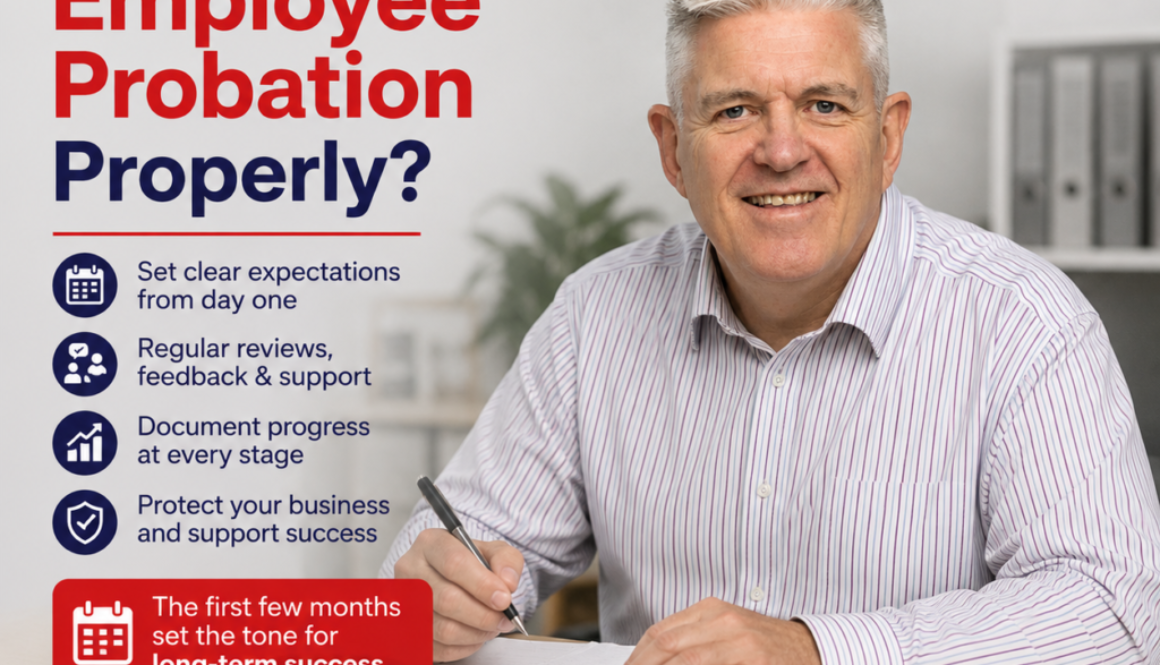
One of the most common situations we see when supporting businesses is an employee approaching the end of their probationary period and the manager suddenly asking: “What are we going to do about their probation?”
Our response is often another question: “What have you been doing throughout their probation?”
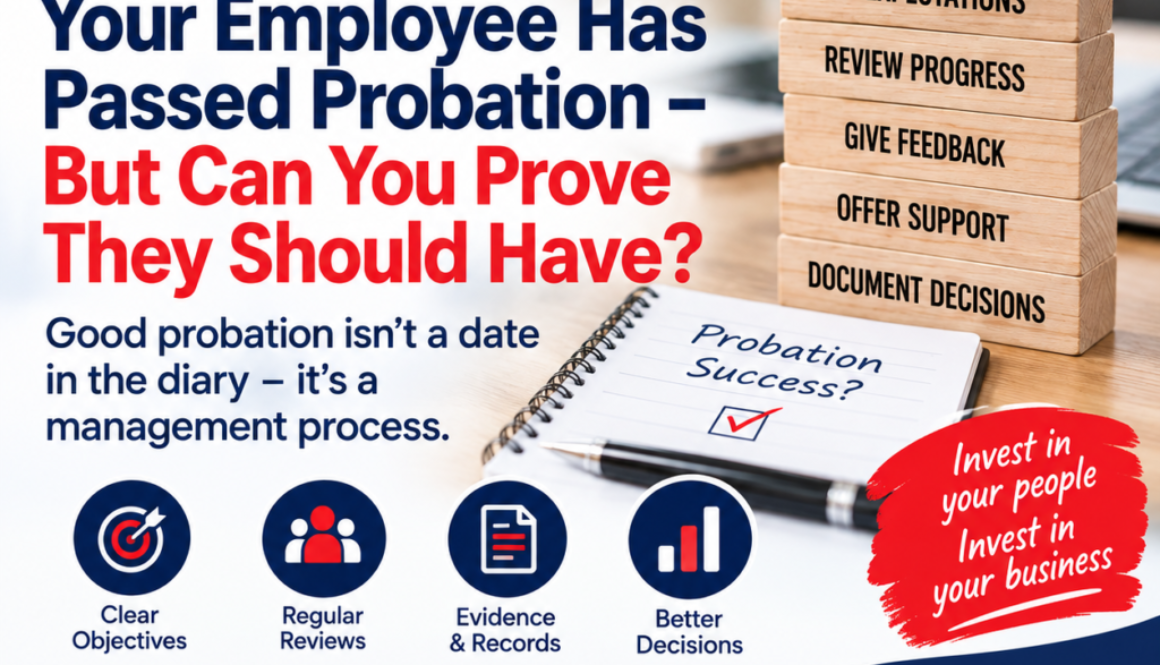
Because a probationary period should never simply be a date entered into the calendar when somebody joins the company. It should be an active management process from Day One.
Why probation management is becoming even more important
From 1 January 2027, the qualifying period for ordinary unfair dismissal protection will reduce from the current two years to six months. The Government has specifically advised employers using contractual probation periods to consider how those arrangements will operate alongside the new six-month qualifying period. Government guidance.
ACAS also emphasises that probation gives employers an opportunity to assess performance, skills and suitability while giving the employee the opportunity to decide whether the role and organisation are right for them. ACAS guidance.
Probation is not a date in the diary – it is a management process.
“But they’re still on probation…”
Being on probation does not mean an employee has no employment rights. Employees can have important rights from the beginning of employment, including protection against discrimination and certain automatically unfair reasons for dismissal.
This is why managers should never assume: “They’re in probation, so we can just get rid of them.” There should still be a genuine business reason for the decision and an appropriate process.
What should actually happen during probation?
A well-managed probationary period should start when the employee joins the organisation – not a few days before the probation expiry date.
Expectations are clear from the beginning. The employee should understand their role, responsibilities, standards and objectives.
SMART objectives are agreed. What does successful performance actually look like, and how will it be measured?
Regular probation meetings take place. Don’t wait until the final week. Review progress throughout the probation period.
Concerns are raised when they happen. If something is not right in week four, discuss it in week four – not month six.
Support and training are provided. Employees should have a reasonable opportunity to understand and achieve the required standards.
Everything is documented. Keep notes of meetings, objectives, concerns, support and agreed actions.
A clear decision is made before probation expires. Confirm whether the employee has passed, whether an extension is appropriate where contractually permitted, or whether employment should end following an appropriate process.
ACAS guidance says that where probation is extended, the employer should tell the employee in writing before the original probation expires and agree matters such as the extension period, review points, improvement expectations, training and final review. Read more from ACAS.
The dangerous “automatic pass”
Imagine this situation. An employee has a six-month probationary period. Month one – a few concerns. Month two – the manager says performance needs to improve. Month three – another informal conversation. Month four – nothing documented. Month five – the manager is busy. Month six – the probation expiry date passes.
Two weeks later the manager contacts HR: “They’ve never really been performing. Can we extend their probation?”
That is exactly the kind of situation businesses should be avoiding. Good HR is about dealing with people issues proactively rather than reactively.
Comment from Matthew Chilcott – Owner, Consensus HR
“One of the biggest mistakes I continue to see is businesses putting a probation end date in the diary and then doing very little until that date arrives.
Throughout my career, I have always believed that probation should be an active management process. A new employee should know what is expected of them, how their performance will be measured and whether they are achieving the required standard.
If there is a problem in month one, talk about it in month one. Don’t wait until the end of probation and suddenly produce a list of concerns the employee has never previously heard.
With unfair dismissal protection changing from January 2027, getting recruitment, induction and probation right is going to become even more important.”
Matthew Chilcott – Owner, Chartered FCIPD, ACEL, BA (Hons)
Is your probation process ready for 2027?
Now is the time for employers to review:
Contracts of Employment
Probation clauses
Induction processes
Probation documentation
Manager training
SMART objectives
Performance records
At Consensus HR, we also provide our structured Probationary Period Workbook, designed to help businesses and managers properly manage and document the first months of employment.
Because the best time to discover that somebody is not right for your business is during a properly managed probation process – not months afterwards.
Need HR support?
Consensus HR provides outsourced HR & Employment Law support to businesses throughout Hertfordshire, Bedfordshire and Cambridgeshire.
“We haven’t got time.” “They know they’re not performing.” “We’ll do the paperwork later.” Sound familiar?
Over the next three Thursdays, Consensus HR is looking at some of the most common excuses we hear when businesses have not completed essential HR processes — and, more importantly, what can happen when an apparently small shortcut turns into a much bigger people problem.
Good HR is not about producing paperwork for the sake of it. It is about making sure employees know what is expected, managers know how to manage and the business can demonstrate what it has done if a situation later becomes disputed.
Excuse 1: “We Haven’t Got Time to Complete the Probation Review”
Our answer: Make time.
If your business has invested time and money recruiting somebody, their probationary period should be actively managed. Probation should not consist of putting a date in the diary for three or six months’ time and hoping everything goes well.
Managers should discuss performance, conduct, attendance, training, objectives and any areas requiring improvement throughout probation. If there is a problem, tell the employee, give clear examples, explain what improvement is required, offer appropriate support and set a review date.
What could happen if you don’t? Problems may continue until the end of probation, leaving the employee able to say: “Nobody ever told me there was a problem.” Employers should also remain mindful of contractual obligations and legal risks including discrimination and automatically unfair dismissal protections.
Manage probation from day one — not on the final day.
Excuse 2: “They Know They’re Not Performing — I’ve Told Them Loads of Times”
Our answer: What does your documentation show?
Managers frequently tell us that they have spoken to an employee “loads of times”. We then ask: When? What was discussed? What examples were given? What improvement was required? Was a timescale agreed? Was support or training offered? When was it going to be reviewed?
Not every management conversation needs to become a formal HR process. Informal conversations are an extremely important management tool. But important conversations should be appropriately documented.
What could happen if you don’t? Months later, the employee may remember events differently. Instead of clear evidence of repeated discussions, the position can become “I definitely told them” versus “No, you didn’t.” A simple contemporaneous note or follow-up email can make the position considerably clearer.
If the conversation matters, appropriately record it.
Excuse 3: “We’ll Sort the Paperwork Out Later”
Our answer: Later has an unfortunate habit of becoming never.
Employment documentation is not simply administration. Written records provide clarity about what has been agreed and can help prevent misunderstandings later.
This can apply to probation, performance, sickness absence, flexible working, reasonable adjustments, disciplinary and grievance matters, training and changes to employment arrangements. Records containing personal information must also be handled appropriately under applicable data-protection requirements.
What could happen if you don’t? Managers leave. Employees leave. Memories fade. Circumstances change. Six months later somebody asks, “What did we actually agree?” — and nobody can prove the answer.
Comment from Matthew Chilcott — Owner, Consensus HR
“One of the biggest mistakes I see businesses make is believing that dealing with HR properly takes too much time. In reality, the conversations managers avoid and the paperwork they don’t complete are often exactly the things that take considerably more management time when a problem develops later.
Probation is a perfect example. Don’t recruit somebody, leave them largely unmanaged for three or six months and then suddenly decide at the end that they are not suitable. Manage from day one. Talk regularly. Set clear expectations. Document the important points and deal with concerns when they arise.
Twenty minutes spent managing something properly today could save hours, days or even weeks further down the line.”
Matthew Chilcott — Owner, FCIPD, ACEL, BA (Hons)
Next Thursday…
Part Two: “But We’re Only a Small Business!” We tackle three more familiar excuses, including why being an SME does not mean employment law can simply be ignored — and why “everyone knows the rules” can be a dangerous assumption.
Need practical HR support?
Consensus HR supports SMEs across Hertfordshire, Bedfordshire and Cambridgeshire with practical, proactive HR and Employment Law support.
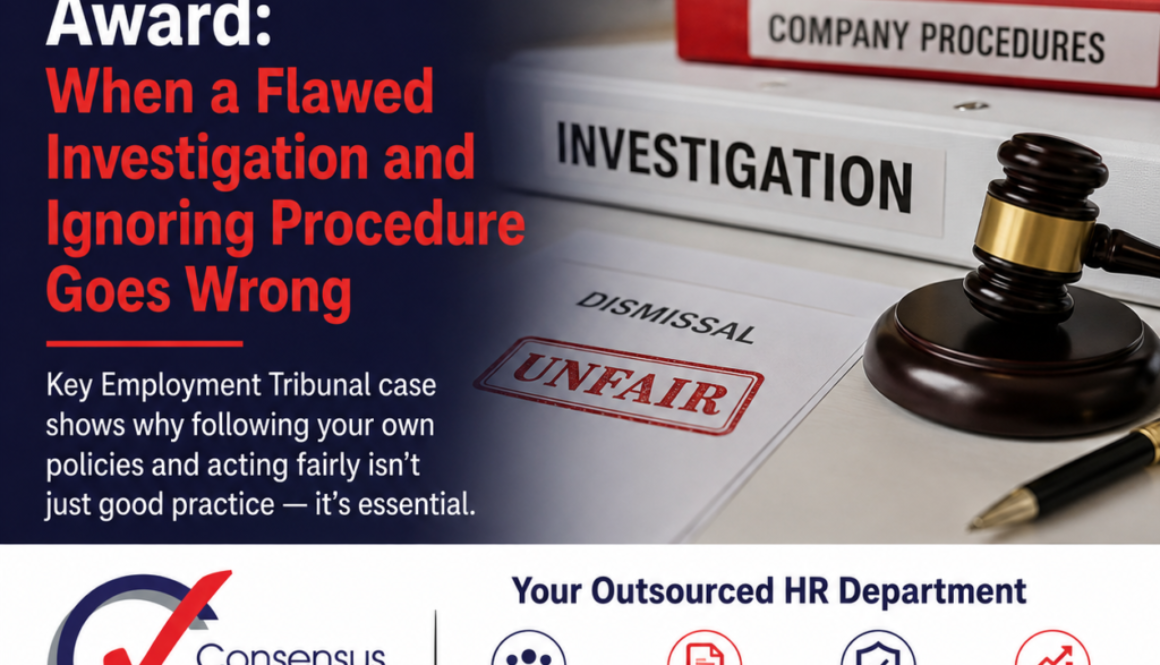
£118,888 Unfair Dismissal Award: When a Flawed Investigation and Ignoring Procedure Goes Wrong
An employer’s failure to follow its own procedures, combined with what the Employment Tribunal found to be a deeply flawed investigation, resulted in a finding of unfair dismissal.
Award: £118,888.50
Consensus HR summary: A disciplinary process should never begin with a conclusion already in mind. Employers need to investigate fairly, consider evidence both for and against the allegation, follow their own contractual and disciplinary procedures and ensure the person making the final decision has the authority to do so.
The Law
Section 98 of the Employment Rights Act 1996 sets out the framework for determining whether a dismissal is fair or unfair. An employer must establish a potentially fair reason for dismissal and, under section 98(4), the tribunal then considers whether the employer acted reasonably in treating that reason as sufficient for dismissal, taking account of the circumstances, including the size and administrative resources of the employer.
In conduct cases, a fair process is also critical. ACAS guidance makes clear that investigations should be fair and objective, should gather evidence from all sides and should not be conducted simply to prove an employee’s guilt.
The Facts
The claimant had worked for the respondent for around 17 years and was an interim Joint Director of Estates and Facilities. The Employment Tribunal was told that, before the events leading to dismissal, the claimant had provided “loyal and unblemished service”.
Following a serious road traffic incident involving the claimant’s family, the claimant became the main carer for their parents and their own vehicle was written off. A replacement vehicle was ordered through the respondent’s salary sacrifice scheme, but there was a 14-month wait for delivery. During that period, the claimant used pool cars and demonstration vehicles which had been provided to the respondent free of charge by a manufacturer.
At around the same time, the respondent began a restructure. The claimant and another executive were required to re-apply for their jobs and were encouraged to consider other roles within the organisation.
In the weeks following the restructure announcement, an anonymous letter was sent to the CEO alleging that the claimant had arranged for demonstration vehicles to be obtained instead of replacing their own car. This led to an investigation and a disciplinary allegation that the claimant had used their “position, influence and office to obtain personal gain from the Trust lease car scheme and/or commercial partners”.
The disciplinary hearing resulted in dismissal for gross misconduct and the claimant brought a claim for unfair dismissal.
Employment Tribunal Decision
Important: This was an Employment Tribunal decision and is not binding authority on other tribunals. It can be persuasive and provides a useful indication of how similar procedural failings may be viewed.
1. The employer did not follow its own procedure
The claimant’s contract gave authority to dismiss to the respondent’s CEO. However, the decision to terminate employment was made by another manager. The Tribunal identified this as one of several examples of the respondent failing to follow its own procedures.
2. The investigation was not even-handed
The Tribunal found evidence of bias and concluded that the investigation had been conducted in a way that sought to validate misconduct rather than approach the matter objectively. The Tribunal also criticised the fact that the investigation had been carried out by somebody more junior than the claimant when, under the respondent’s arrangements, this should not have happened.
3. There was no evidence of dishonesty
The Tribunal found no evidence that the claimant had acted dishonestly. The claimant genuinely believed that using the demonstration vehicles was permitted and had been open and straightforward throughout the disciplinary process.
4. Senior management knew about the vehicle use
The Tribunal was satisfied that senior management were aware the claimant was using the demonstration vehicles. It also concluded that, had the claimant been told to stop, they would have done so immediately.
5. The findings did not support gross misconduct
The disciplinary panel itself found that the claimant had not sought to enrich themselves or deliberately use their position for personal gain, yet still dismissed for gross misconduct. The appeal panel then upheld the dismissal despite finding that the claimant was not guilty of gross misconduct but of serious misconduct. The Tribunal described this as the “strangest of decisions”.
6. The Tribunal considered the wider restructuring context
The Tribunal found no evidence that the claimant had used their position for personal benefit as alleged. It also considered that the respondent had already determined the claimant was surplus to requirements through the restructure and concluded that the gross misconduct allegation had effectively been used as a means of exiting the claimant from the organisation.
Taking the process as a whole, the Tribunal concluded that a reasonable employer in the circumstances would not have dismissed the claimant. The dismissal was therefore unfair and the claimant was awarded £118,888.50.
Takeaway Points for Employers
Follow your own policies and contracts. A well-written procedure offers little protection if managers ignore it.
Check who has authority to dismiss. Contractual and procedural authority should be confirmed before any final decision is made.
Investigate the facts, not a preferred outcome. Evidence which supports the employee’s account must be considered just as carefully as evidence against them.
Use an impartial and appropriately senior investigator. Consider conflicts of interest, reporting lines and organisational hierarchy.
Make sure the allegation matches the evidence. If dishonesty or personal gain is alleged, there should be evidence capable of supporting that allegation.
Consider consistency and proportionality. Gross misconduct should not be used as a convenient label where the facts do not justify it.
Use the appeal properly. An appeal is an opportunity to correct an unsafe decision, not simply approve the original outcome.
Keep restructuring and disciplinary processes genuinely separate. A conduct process should never be used as a shortcut to remove an employee because their role is no longer wanted.
Comment from Matthew Chilcott – Owner, Consensus HR
“This case is an excellent reminder that the outcome of a disciplinary process can only ever be as strong as the investigation and procedure behind it. Employers sometimes focus heavily on the allegation and not enough on whether the process is fair, objective and supported by the evidence.
At Consensus HR we regularly remind managers that an investigator’s role is not to prove that an employee is guilty. Their role is to establish the facts, consider evidence from all sides and determine whether there is a case to answer. The disciplinary manager must then make a reasonable and proportionate decision based on those facts.
When procedures are ignored, decision-makers do not have the correct authority or the evidence does not support the allegation, an employer can turn what might have been a manageable employee-relations issue into a costly Employment Tribunal claim.”
Matthew Chilcott – Owner, FCIPD, ACEL, BA (Hons)
What Should Employers Do Now?
Employers should review their disciplinary and investigation procedures and make sure managers understand how to use them in practice. This includes identifying the correct investigator, setting clear terms of reference, gathering evidence from all sides, documenting findings, ensuring the employee understands the allegation and confirming who has the authority to make disciplinary and appeal decisions.
If your business is considering disciplinary action, particularly where dismissal may be an outcome, obtaining HR advice before the process begins can help ensure the procedure is fair, consistent and compliant.
Consensus HR supports SMEs across Hertfordshire, Bedfordshire and Cambridgeshire with workplace investigations, disciplinary procedures, appeals, Employment Law and day-to-day people management.
Your Outsourced HR & Employment Law Department – helping companies take the pain out of managing people whilst preventing people problems.
The new Fair Work Agency (FWA) has begun its inspection activity, with employers being contacted about forthcoming visits and being told what employment documentation enforcement officers may wish to inspect.
For employers, this is another reminder of why HR compliance cannot simply be dealt with when something goes wrong.
The Fair Work Agency was established on 7 April 2026 under the Employment Rights Act 2025 and is responsible for enforcing a range of employment rights. Its current responsibilities include employment agency conduct, modern slavery and gangmasters licensing, with responsibility for National Minimum Wage enforcement due to transfer fully from HMRC from April 2027.
Inspections Can Be Announced – or Unannounced
Employers may be selected for an inspection to assess whether they are complying with legislation falling within the FWA’s remit.
Importantly, an inspection does not necessarily mean that somebody has made a complaint.
Inspections may be prearranged or unannounced.
Where an inspection is arranged in advance, employers will usually receive an email explaining what documentation the FWA wishes to inspect and the deadline for providing it.
The documents requested will depend upon the organisation and the reason for the inspection. For example, an employment agency could be asked to provide workers’ contracts, Key Information Documents and terms of business with clients.
What Can Fair Work Agency Enforcement Officers Do?
Employers should understand that an FWA inspection can involve considerably more than somebody simply asking to see a few HR documents.
Enforcement officers may examine documents, require individuals to produce or explain records, inspect business premises and inspect computers or other equipment used to process or store relevant information.
They may also require information to be provided, issue notices of underpayment, seize documents where authorised and potentially extend an investigation to relevant labour providers or users.
This makes good record keeping increasingly important. Employment documentation should not only be legally compliant – it needs to be accurate, current, organised and accessible.
What Happens If a Business Does Not Cooperate?
This is an area employers should take particularly seriously.
Obstructing an enforcement officer or providing false documentation may constitute a criminal offence.
Refusing to provide information, preventing access to premises, failing to comply with instructions or hindering the removal of documents may result in enforcement action, potentially including prosecution, civil penalties, criminal investigation or Labour Market Enforcement Orders.
The message for employers is straightforward: do not wait until an enforcement officer arrives before checking whether your HR records are in order.
Would Your HR Records Stand Up to Inspection?
At Consensus HR, we regularly talk about being proactive rather than reactive when managing people.
An FWA inspection is a good example of why.
Are our Contracts of Employment up to date?
Can we easily demonstrate that employees and workers have received the correct documentation?
Are our payroll and working-time records accurate and accessible?
Are National Minimum Wage requirements being correctly followed?
Are Right to Work records complete and stored correctly?
Are our HR policies and procedures current?
Do managers know what to do if an enforcement officer arrives at the business?
Could we confidently produce the information requested within a specified deadline?
If the answer to any of those questions is “I’m not sure”, now is the time to check.
The Importance of Management Awareness
It is not enough for HR documentation simply to exist somewhere on a computer.
Senior managers and those responsible for employees need to understand the organisation’s HR processes and know where relevant records are held.
Businesses should also have a clear process for dealing with an inspection. If an enforcement officer attends unexpectedly, employees and managers need to know who should be contacted internally and who is authorised to deal with the inspection.
A confused response can make an already challenging situation significantly harder.
Comment from Matthew Chilcott – Owner, Consensus HR
“The arrival of the Fair Work Agency is another significant change for UK employers and reinforces something we have always encouraged our clients to do – manage HR proactively rather than waiting for a problem.
An employer may believe everything is fine because nobody has complained, but an inspection does not necessarily need to follow a complaint.
If somebody arrived at your business and asked to see your employment documentation, contracts and relevant records, how quickly could you produce them and how confident would you be that everything was legally compliant and up to date?
That is the question I would encourage every SME owner and manager to ask.
Good HR is not about producing paperwork for the sake of paperwork. It is about having clear, commercial and compliant people-management processes that you can demonstrate when required.”
Matthew Chilcott – Owner, FCIPD, ACEL, BA (Hons)
Preparing Your Business Now
The Fair Work Agency does not yet have the full range of enforcement responsibilities it is expected to have in the future.
That makes 2026 an important opportunity for employers to review their HR compliance before the enforcement landscape develops further.
At Consensus HR, we work with SMEs across Hertfordshire, Bedfordshire and Cambridgeshire, helping businesses ensure their employment documentation, HR policies and people-management processes are legally compliant and practically workable.
Our retained clients benefit from ongoing HR and Employment Law support, helping them remain proactive as legislation and employer responsibilities change.
If you are unsure whether your HR documentation would withstand scrutiny, we can undertake an HR review and identify areas that may need attention.
Need HR & Employment Law Support?
Consensus HR – Your Outsourced HR Department
Helping companies take the pain out of managing people through clear, commercial and compliant people management.
When one of those stages is missing, problems can appear later.
A candidate may have had the right experience and performed extremely well at interview, but if nobody clearly explains what success looks like once they start, how can they confidently deliver it?
What Does Good Look Like?
Managers often assume employees know what is expected.
That assumption can cause problems.
A new employee should understand:
Their key responsibilities
Performance standards
Who they report to
Their objectives
Required behaviours
Company policies and procedures
Training requirements
How performance will be measured
When probation reviews will take place
Where to go when they need help
ACAS describes induction – sometimes called onboarding – as the process of welcoming somebody into an organisation or role and notes that a well-structured induction helps people understand what is expected of them.
The First Few Weeks Matter
Think about the difference between these two approaches.
Business A
“Welcome aboard. There’s your desk. Sarah will show you the system. Shout if you need anything.”
Business B
Provides a planned induction, Job Description, clear responsibilities, training programme, objectives, regular manager check-ins and documented probation reviews.
Which business is more likely to know whether its recruitment decision was successful?
Comment from Matthew Chilcott – Owner, Consensus HR
Businesses often tell me that somebody “just hasn’t worked out”.
My first question is usually: What process was followed?
Was there a clear Job Description?
Were expectations discussed?
Was there a proper induction?
Were SMART objectives agreed?
Did the manager hold probation reviews?
Were concerns raised when they first occurred?
Was everything documented?
If the answer to most of those questions is no, the problem may not simply be the employee.
Good recruitment needs good management afterwards.
Recruitment and Performance Are Connected
ACAS’s latest probation guidance makes an interesting point: if an organisation regularly has employees failing probation, there may be an issue with its recruitment process.
That is why businesses should not treat recruitment, induction, probation and performance management as separate HR activities.
They are all part of the same employee journey.
Is Your Recruitment Process Protecting Your Business?
Consensus HR works with SMEs across Hertfordshire, Bedfordshire and Cambridgeshire to create practical, legally informed recruitment and people-management processes.
Recruitment is only the beginning of the employment relationship, and what happens during the employee’s first few months can become increasingly important for UK employers.
Probation Is Not Just a Date in the Diary
Too many organisations put a probationary period into the Contract of Employment and then forget about it until a reminder appears shortly before the end.
That defeats much of the purpose of probation.
A structured probationary process should help the employer assess:
Performance
Capability
Conduct
Attendance
Training requirements
Understanding of the role
Integration into the business
Whether expectations are being achieved
It should also allow the employee to raise questions, discuss concerns and obtain the support they need.
Why 2027 Makes This Even More Important
Under the Employment Rights Act 2025, the qualifying period for ordinary unfair dismissal protection is scheduled to reduce from two years to six months from 1 January 2027.
This means employers should be reviewing their recruitment and probation processes now.
Importantly, probation itself does not remove employment rights.
Employees can already have important protections from the beginning of employment, including in relation to discrimination and certain automatically unfair reasons for dismissal.
A probationary clause is therefore not a licence simply to dismiss somebody without considering the circumstances and following an appropriate process.
Don’t Wait Until Month Three or Six
A good probationary process involves regular checkpoints.
At Consensus HR, we advocate structured discussions throughout the probationary period rather than leaving everything until the end.
For example:
Week 1 – Initial expectations and settling in Week 2 – Early progress and training Month 1 – Formal progress review Month 2 – Performance and development review Month 3 – Formal probation review and appropriate next steps
The exact structure should reflect the role and agreed probation period, but the principle is straightforward:
Review. Discuss. Support. Document.
Comment from Matthew Chilcott – Owner, Consensus HR
“One of the biggest mistakes I see is businesses leaving probation until the very end.
I have used structured probationary management throughout my HR career, including within Forte Restaurants, Welcome Break and Three Valleys/Veolia Water.
Probation should be an active management tool, not simply a clause within somebody’s Contract of Employment.
If an employee is struggling in week three, why wait until month three to tell them?
Early conversations give people the opportunity to improve and give the employer evidence that the process has been properly managed.
With the unfair dismissal qualifying period reducing to six months from January 2027, getting probation right is becoming even more important.”
What If Performance Isn’t Good Enough?
Do not automatically jump to dismissal.
Consider:
Has the required standard been explained?
Has the employee received sufficient training?
Have concerns been discussed?
Has reasonable time been allowed to improve?
Is additional support required?
Could there be a disability or another protected issue to consider?
Does the Contract or policy allow probation to be extended?
Has everything been documented?
ACAS’s updated probation guidance states that dismissal during probation should be a last resort, with employers considering performance-management support or, where appropriate, an extension.
Our Probationary Period Workbook
Consensus HR can provide businesses with a structured First Three Months Probationary Period Workbook, helping managers follow a consistent process from the employee’s first week.
Ask us how the workbook can support your recruitment and probation process.
Recruiting the Right Person Is Only Half the Job – Keeping Them Is the Real Challenge
By Consensus HR – Outsourced HR Support for SMEs
Recruitment is expensive.
Advertising, interviewing, onboarding and training all require significant investment.
Yet many businesses lose excellent employees within the first year—not because they recruited the wrong person, but because they failed to support them after they joined.
Successful retention starts on day one
Retention isn’t created through annual pay reviews.
It begins during recruitment and continues throughout onboarding, probation and ongoing management.
Successful employers provide:
Structured inductions
Regular feedback
Clear expectations
SMART objectives
Training opportunities
Open communication
Recognition
Employees who understand what success looks like are far more likely to remain engaged.
Managers make the biggest difference
Research consistently shows that people often leave managers rather than companies.
Investing in management development often produces a greater return than increasing recruitment budgets.
Comment from Matthew Chilcott – Owner, Consensus HR
“Businesses often spend thousands recruiting the right person but very little ensuring they stay. Great retention comes from excellent management, regular communication and making employees feel valued from their very first day. Prevention has always been far less expensive than replacing good people.”
How Consensus HR helps
We work with SMEs to improve:
Recruitment
Contracts of Employment
Onboarding
Probation programmes
Employee Handbooks
Performance management
Management training
Employee engagement
Retention strategies
Helping businesses reduce recruitment costs whilst building stronger, more productive teams.
If you’d like to improve employee retention, we’d love to help.
Why Businesses Should Stop Waiting Until There Is a Problem Before Calling HR
Helping companies take the pain out of managing people
By Consensus HR – Your Outsourced HR Department for Hertfordshire, Bedfordshire & Cambridgeshire
Are You Managing Your People… or Simply Reacting to Problems?
For many SMEs, HR is still viewed as something only needed when there is an issue.
An employee resigns unexpectedly.
Someone raises a grievance.
Performance drops.
Absence increases.
A disciplinary becomes unavoidable.
Or worse still…
A letter arrives notifying the business of an Employment Tribunal claim.
Only then does the search begin for professional HR advice.
Unfortunately, by that stage the problem has often been developing for months and could have been prevented.
At Consensus HR, we firmly believe that effective Human Resources is about prevention rather than cure. Just as you wouldn’t wait until your accounts were in disarray before speaking to your accountant or until your computer systems crashed before calling your IT provider, your people deserve the same proactive attention.
As your outsourced HR Department, we work alongside businesses throughout Hertfordshire, Bedfordshire and Cambridgeshire, ensuring they remain compliant with UK Employment Law while creating productive, engaged workplaces.
HR Is Not About Firefighting
One of the biggest misconceptions surrounding HR is that it only becomes important when something goes wrong.
In reality, the best HR professionals spend most of their time ensuring issues never develop in the first place.
That includes:
Reviewing Contracts of Employment.
Keeping Employee Handbooks fully up to date.
Supporting managers before difficult conversations become formal procedures.
Monitoring probationary periods.
Providing practical Employment Law advice.
Delivering management training.
Assisting with recruitment.
Supporting employee wellbeing.
Helping businesses plan ahead.
The result?
Fewer grievances.
Fewer disciplinaries.
Lower absence.
Higher engagement.
Greater productivity.
And significantly less legal risk.
Small Problems Rarely Stay Small
Very few Employment Tribunal claims arise because of one isolated incident.
Instead, they usually develop from a series of small management decisions that weren’t addressed at the time.
For example:
A manager delays giving feedback because they don’t want conflict.
An employee’s poor performance isn’t documented.
Probation meetings are repeatedly postponed.
Policies haven’t been updated for several years.
Managers deal with situations inconsistently.
Employees begin to feel unfairly treated.
Communication breaks down.
Eventually the employee leaves—or brings a legal claim.
All of this could often have been prevented through timely HR advice.
The Cost of Doing Nothing
Many businesses avoid seeking HR advice because they see it as an unnecessary expense.
However, the real expense often comes from not asking for help.
Consider the hidden costs of poor people management:
Lost management time.
Recruitment costs.
Reduced productivity.
Increased sickness absence.
Low employee morale.
Damage to reputation.
Legal expenses.
Employment Tribunal awards.
Even one poorly handled dismissal can cost significantly more than a year’s professional HR support.
Employment Law Continues to Change
UK Employment Law never stands still.
Recent legislative developments and forthcoming reforms mean employers need to be more proactive than ever.
Businesses should regularly review:
Contracts of Employment.
Employee Handbooks.
Family-friendly policies.
Flexible working procedures.
Equality policies.
Disciplinary procedures.
Grievance procedures.
Recruitment practices.
Probation management.
Keeping documentation current isn’t simply best practice—it demonstrates that your business takes compliance seriously.
Managers Should Never Feel Alone
One of the biggest benefits our retained clients tell us they value is simply knowing someone is available to ask.
Managers regularly face situations they’ve never encountered before.
Questions such as:
“Can we extend probation?”
“How do we deal with repeated lateness?”
“Can we refuse this flexible working request?”
“Do we need an investigation?”
“Should Occupational Health be involved?”
“What documentation do we need?”
Receiving professional advice before making a decision often prevents far bigger problems later.
What Makes Consensus HR Different?
Unlike many HR providers, we don’t simply wait for clients to contact us after something has gone wrong.
Our retained service is built around proactive support.
We help clients by providing:
Unlimited HR advice.
Employment Law updates.
Employee Handbook reviews.
Contract updates.
Weekly retained client briefings.
Management guidance.
Recruitment support.
Performance management assistance.
Workplace investigations.
Disciplinary and grievance support.
Absence management.
Occupational Health guidance.
Management training.
Breathe HR support.
HR documentation.
Practical commercial advice.
Our objective is simple:
To prevent people problems before they become expensive business problems.
Comment from Matthew Chilcott – Owner, FCIPD, ACEL, BA (Hons)
“One of the biggest misconceptions I still encounter is that HR only becomes important when something has already gone wrong. The reality is quite the opposite. The businesses that experience the fewest employee issues are those that seek professional advice early. At Consensus HR we work alongside our clients every week, helping them prevent problems rather than simply resolving them after they have escalated. Prevention will always be more effective—and considerably less expensive—than cure.”
Could Your Business Benefit from Proactive HR Support?
Whether you employ five people or two hundred and fifty, having experienced HR professionals available whenever you need them provides confidence, reassurance and legal protection.
Our retained clients enjoy ongoing support that helps them stay compliant, develop their managers and create productive workplaces.
About Consensus HR
Consensus HR provides outsourced Human Resources and Employment Law support for businesses throughout:
Hertfordshire
Bedfordshire
Cambridgeshire
Our experienced team works as your own HR Department, delivering practical, commercial advice designed specifically for SMEs.
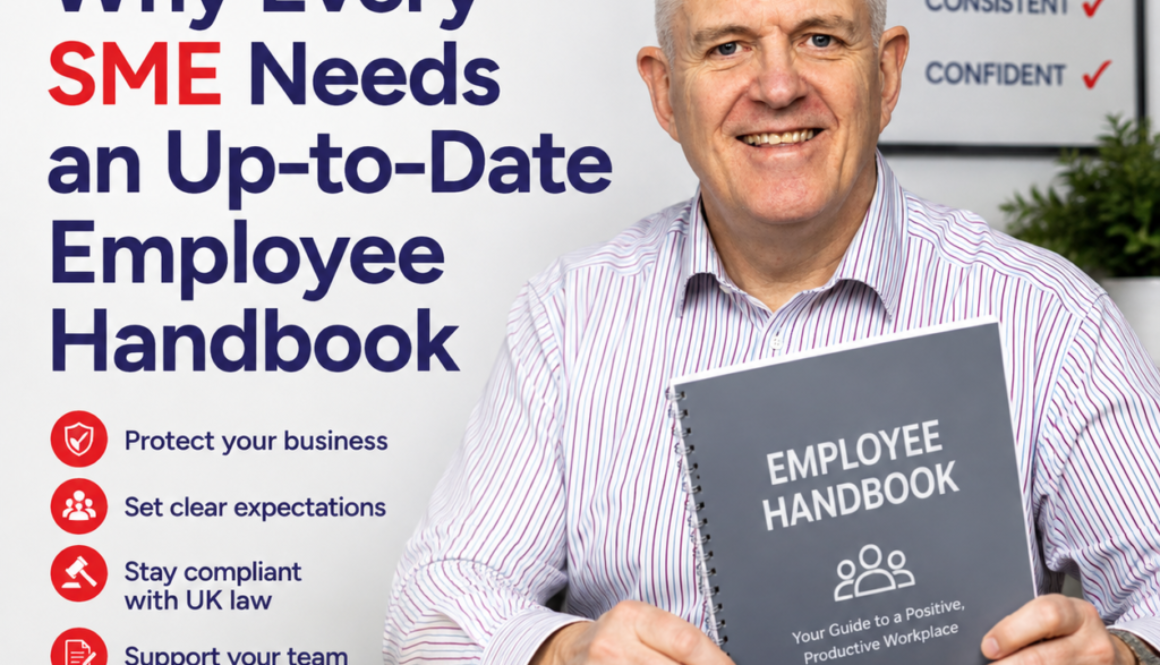
Why Your Employee Handbook Should Be One of Your Most Used Business Documents
By Consensus HR – Helping Businesses Take the Pain out of Managing People
Too often we hear the same comment:
“Our handbook is over 100 pages long… nobody reads it.”
Our response is always the same.
If nobody reads it…
…why have one?
An Employee Handbook should never sit on a shelf collecting dust.
It should be a practical guide that managers use every week and employees can easily access whenever they need information.
A handbook should support your business every day
A professionally written handbook helps businesses:
Set expectations
Create consistency
Demonstrate fairness
Protect against legal claims
Build trust
Improve communication
The most successful businesses don’t just issue a handbook during induction.
They actively use it.
Is yours up to date?
Employment Law continues to evolve.
Policies surrounding family leave, flexible working, harassment, disciplinary procedures and many other employment matters require regular review.
An outdated handbook can create unnecessary risk.
Comment from Matthew Chilcott – Owner, Consensus HR
“One of the biggest mistakes I see is businesses assuming their handbook only needs updating every few years. Employment Law changes continuously and your documentation should evolve alongside it. At Consensus HR, retained clients who have purchased their Employee Handbook through us receive updated versions whenever legislation changes, together with training notes to help managers and employees understand what has changed. Your handbook should become your company’s HR bible.”
Why retained clients benefit
Clients retaining our monthly HR service who have purchased their handbook through us receive:
Regular legal updates
Updated handbook sections
Guidance notes
Support implementing changes
Manager advice
Employee communication support
Helping ensure everyone understands not only what has changed—but why.
We use cookies on our website to give you the most relevant experience by remembering your preferences and repeat visits. By clicking “Accept All”, you consent to the use of ALL the cookies. However, you may visit "Cookie Settings" to provide a controlled consent.
This website uses cookies to improve your experience while you navigate through the website. Out of these, the cookies that are categorized as necessary are stored on your browser as they are essential for the working of basic functionalities of the website. We also use third-party cookies that help us analyze and understand how you use this website. These cookies will be stored in your browser only with your consent. You also have the option to opt-out of these cookies. But opting out of some of these cookies may affect your browsing experience.
Necessary cookies are absolutely essential for the website to function properly. These cookies ensure basic functionalities and security features of the website, anonymously.
Cookie
Duration
Description
cookielawinfo-checkbox-analytics
11 months
This cookie is set by GDPR Cookie Consent plugin. The cookie is used to store the user consent for the cookies in the category "Analytics".
cookielawinfo-checkbox-functional
11 months
The cookie is set by GDPR cookie consent to record the user consent for the cookies in the category "Functional".
cookielawinfo-checkbox-necessary
11 months
This cookie is set by GDPR Cookie Consent plugin. The cookies is used to store the user consent for the cookies in the category "Necessary".
cookielawinfo-checkbox-others
11 months
This cookie is set by GDPR Cookie Consent plugin. The cookie is used to store the user consent for the cookies in the category "Other.
cookielawinfo-checkbox-performance
11 months
This cookie is set by GDPR Cookie Consent plugin. The cookie is used to store the user consent for the cookies in the category "Performance".
viewed_cookie_policy
11 months
The cookie is set by the GDPR Cookie Consent plugin and is used to store whether or not user has consented to the use of cookies. It does not store any personal data.
Functional cookies help to perform certain functionalities like sharing the content of the website on social media platforms, collect feedbacks, and other third-party features.
Performance cookies are used to understand and analyze the key performance indexes of the website which helps in delivering a better user experience for the visitors.
Analytical cookies are used to understand how visitors interact with the website. These cookies help provide information on metrics the number of visitors, bounce rate, traffic source, etc.
Advertisement cookies are used to provide visitors with relevant ads and marketing campaigns. These cookies track visitors across websites and collect information to provide customized ads.
Other uncategorized cookies are those that are being analyzed and have not been classified into a category as yet.
Manage Consent
To provide the best experiences, we use technologies like cookies to store and/or access device information. Consenting to these technologies will allow us to process data such as browsing behaviour or unique IDs on this site. Not consenting or withdrawing consent, may adversely affect certain features and functions.
Functional
Always active
The technical storage or access is strictly necessary for the legitimate purpose of enabling the use of a specific service explicitly requested by the subscriber or user, or for the sole purpose of carrying out the transmission of a communication over an electronic communications network.
Preferences
The technical storage or access is necessary for the legitimate purpose of storing preferences that are not requested by the subscriber or user.
Statistics
The technical storage or access that is used exclusively for statistical purposes.The technical storage or access that is used exclusively for anonymous statistical purposes. Without a subpoena, voluntary compliance on the part of your Internet Service Provider, or additional records from a third party, information stored or retrieved for this purpose alone cannot usually be used to identify you.
Marketing
The technical storage or access is required to create user profiles to send advertising, or to track the user on a website or across several websites for similar marketing purposes.







Comment from Matthew Chilcott – Owner, Consensus HR
“The arrival of the Fair Work Agency is another significant change for UK employers and reinforces something we have always encouraged our clients to do – manage HR proactively rather than waiting for a problem.
An employer may believe everything is fine because nobody has complained, but an inspection does not necessarily need to follow a complaint.
If somebody arrived at your business and asked to see your employment documentation, contracts and relevant records, how quickly could you produce them and how confident would you be that everything was legally compliant and up to date?
That is the question I would encourage every SME owner and manager to ask.
Good HR is not about producing paperwork for the sake of paperwork. It is about having clear, commercial and compliant people-management processes that you can demonstrate when required.”
Matthew Chilcott – Owner, FCIPD, ACEL, BA (Hons)