|
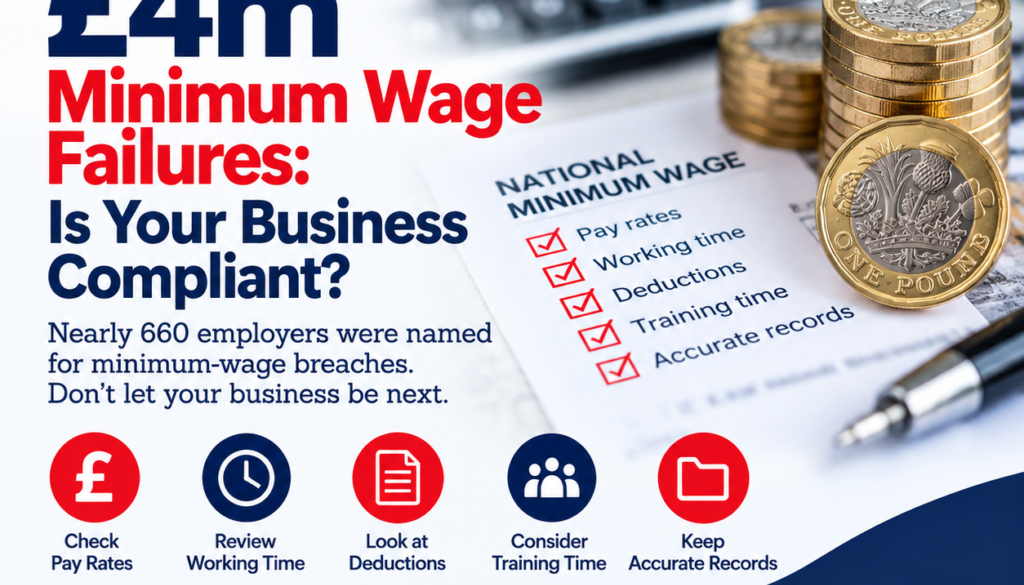
“We pay everyone above minimum wage, so we’re fine.” Are you sure? On 3 September 2026, the Government announced that nearly 660 employers had been named for failing to pay workers the National Minimum Wage. Around £4 million was repaid to more than 27,000 workers, while penalties issued to the employers involved totalled approximately £7 million. Read the Government announcement.
Minimum Wage compliance is not always as simple as looking at somebody’s hourly rate.
“We pay above minimum wage” isn’t the end of the conversationAn employee’s headline hourly rate may appear perfectly compliant. However, employers also need to understand what counts as working time and whether particular deductions or employment practices affect minimum-wage calculations. Problems can arise around areas such as: - Working time
- Training
- Deductions
- Uniform requirements
- Unpaid additional time
- Poor time records
Something that looks like a relatively minor administrative practice can potentially create a much larger compliance problem when multiplied across several employees and a significant period of time. What happens if an employer gets it wrong?Where minimum-wage underpayment is established, an employer can be required to repay arrears to the affected worker. There can also be a financial penalty of up to 200% of the minimum-wage arrears, subject to a maximum of £20,000 per worker under the applicable enforcement rules. Government enforcement guidance. And then there is something that can be even harder to repair: reputation.The Government publicly names employers that meet the relevant criteria for minimum-wage breaches. For an SME that has spent years building its reputation with customers, employees and prospective recruits, appearing on such a list is unlikely to be welcome publicity. Could your everyday working practices be creating a problem?Ask yourself: - Do employees arrive early to prepare before their paid shift begins?
- Are employees required to complete work-related activities after they have clocked out?
- Do employees undertake compulsory training outside their normal paid hours?
- Are deductions being made from wages?
- Are employees required to buy items connected with their employment?
- Are your working-time records accurate?
A payroll system can only process the information it receives. If the underlying HR and management practices are wrong, simply having professional payroll software will not necessarily solve the problem. Five checks we would recommend employers make- Check current pay rates. Ensure everybody is receiving at least the correct statutory rate applicable to them.
- Review actual working time. Look beyond contracted hours. What time are employees actually working?
- Review deductions. Consider whether deductions or employment-related expenditure could affect minimum-wage calculations.
- Check training arrangements. Workers must be paid correctly for working time, including relevant induction and compulsory work-related activities. ACAS induction guidance.
- Keep accurate records. If challenged, could you demonstrate what hours somebody worked and what they were paid?
Comment from Matthew Chilcott – Owner, Consensus HR
“When employers hear about organisations being named for minimum-wage breaches, it can be very easy to think, ‘That would never happen to us because we pay above minimum wage.’
But the hourly rate shown on somebody’s Contract of Employment does not necessarily tell the whole story.
Employers need to understand what people are actually doing, the hours they are actually working and whether any deductions or workplace practices affect the calculation.
HR, management and payroll should work together. A small process error repeated across several employees can potentially become a much bigger and more expensive problem.”
Matthew Chilcott – Owner, Chartered FCIPD, ACEL, BA (Hons)
Proactive HR is cheaper than reactive HRThe latest Government figures provide another reminder of why employers should regularly review their HR practices rather than waiting for something to go wrong. - Nearly 660 employers named.
- More than 27,000 workers affected.
- Around £4 million repaid.
- Approximately £7 million in penalties.
At Consensus HR, our approach has always been about helping businesses become proactive rather than reactive when managing their people. When did you last check your employment practices?If the answer is “I’m not sure”, now might be a good time. Consensus HR supports SMEs throughout Hertfordshire, Bedfordshire and Cambridgeshire with practical HR and Employment Law support.
|