“We pay everyone above minimum wage, so we’re fine.”
Are you sure?
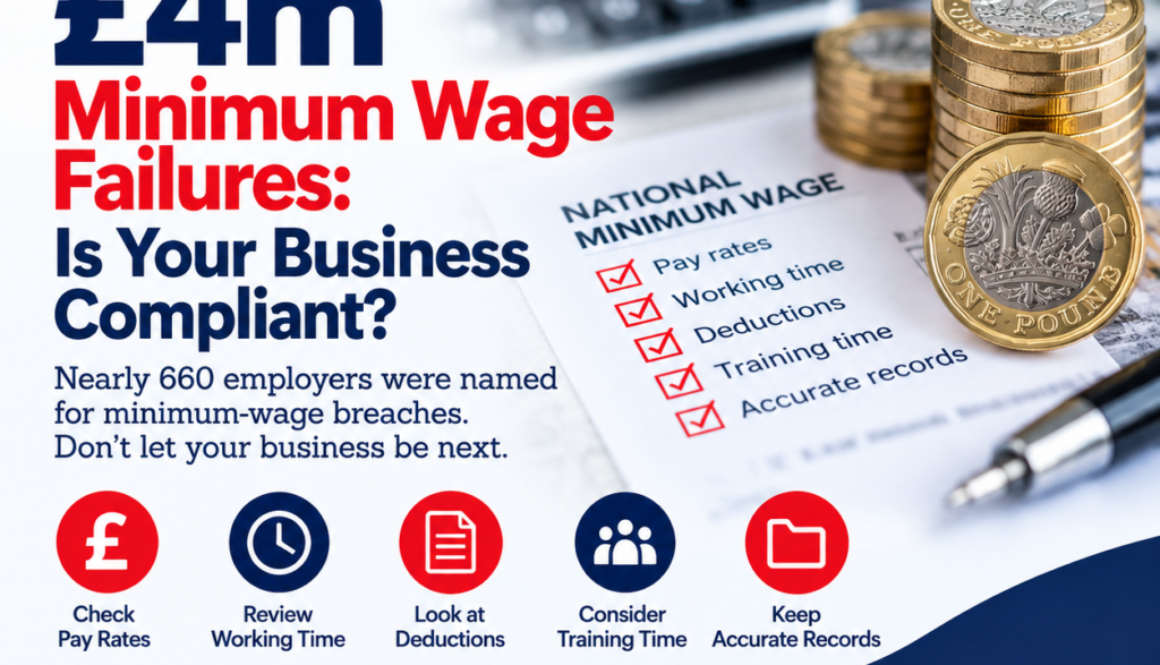
On 3 September 2026, the Government announced that nearly 660 employers had been named for failing to pay workers the National Minimum Wage. Around £4 million was repaid to more than 27,000 workers, while penalties issued to the employers involved totalled approximately £7 million. Read the Government announcement.
Minimum Wage compliance is not always as simple as looking at somebody’s hourly rate.
“We pay above minimum wage” isn’t the end of the conversation
An employee’s headline hourly rate may appear perfectly compliant. However, employers also need to understand what counts as working time and whether particular deductions or employment practices affect minimum-wage calculations.
Problems can arise around areas such as:
Working time
Training
Deductions
Uniform requirements
Unpaid additional time
Poor time records
Something that looks like a relatively minor administrative practice can potentially create a much larger compliance problem when multiplied across several employees and a significant period of time.
What happens if an employer gets it wrong?
Where minimum-wage underpayment is established, an employer can be required to repay arrears to the affected worker.
There can also be a financial penalty of up to 200% of the minimum-wage arrears, subject to a maximum of £20,000 per worker under the applicable enforcement rules. Government enforcement guidance.
And then there is something that can be even harder to repair: reputation.
The Government publicly names employers that meet the relevant criteria for minimum-wage breaches. For an SME that has spent years building its reputation with customers, employees and prospective recruits, appearing on such a list is unlikely to be welcome publicity.
Could your everyday working practices be creating a problem?
Ask yourself:
Do employees arrive early to prepare before their paid shift begins?
Are employees required to complete work-related activities after they have clocked out?
Do employees undertake compulsory training outside their normal paid hours?
Are deductions being made from wages?
Are employees required to buy items connected with their employment?
Are your working-time records accurate?
A payroll system can only process the information it receives. If the underlying HR and management practices are wrong, simply having professional payroll software will not necessarily solve the problem.
Five checks we would recommend employers make
Check current pay rates. Ensure everybody is receiving at least the correct statutory rate applicable to them.
Review actual working time. Look beyond contracted hours. What time are employees actually working?
Review deductions. Consider whether deductions or employment-related expenditure could affect minimum-wage calculations.
Check training arrangements. Workers must be paid correctly for working time, including relevant induction and compulsory work-related activities. ACAS induction guidance.
Keep accurate records. If challenged, could you demonstrate what hours somebody worked and what they were paid?
Comment from Matthew Chilcott – Owner, Consensus HR
“When employers hear about organisations being named for minimum-wage breaches, it can be very easy to think, ‘That would never happen to us because we pay above minimum wage.’
But the hourly rate shown on somebody’s Contract of Employment does not necessarily tell the whole story.
Employers need to understand what people are actually doing, the hours they are actually working and whether any deductions or workplace practices affect the calculation.
HR, management and payroll should work together. A small process error repeated across several employees can potentially become a much bigger and more expensive problem.”
Matthew Chilcott – Owner, Chartered FCIPD, ACEL, BA (Hons)
Proactive HR is cheaper than reactive HR
The latest Government figures provide another reminder of why employers should regularly review their HR practices rather than waiting for something to go wrong.
Nearly 660 employers named.
More than 27,000 workers affected.
Around £4 million repaid.
Approximately £7 million in penalties.
At Consensus HR, our approach has always been about helping businesses become proactive rather than reactive when managing their people.
When did you last check your employment practices?
If the answer is “I’m not sure”, now might be a good time.
Consensus HR supports SMEs throughout Hertfordshire, Bedfordshire and Cambridgeshire with practical HR and Employment Law support.
Recruiting the wrong person and then failing to manage their probation properly can be considerably more expensive.
One of the most common situations we see when supporting businesses is an employee approaching the end of their probationary period and the manager suddenly asking: “What are we going to do about their probation?”
Our response is often another question: “What have you been doing throughout their probation?”
Because a probationary period should never simply be a date entered into the calendar when somebody joins the company. It should be an active management process from Day One.
Why probation management is becoming even more important
From 1 January 2027, the qualifying period for ordinary unfair dismissal protection will reduce from the current two years to six months. The Government has specifically advised employers using contractual probation periods to consider how those arrangements will operate alongside the new six-month qualifying period. Government guidance.
ACAS also emphasises that probation gives employers an opportunity to assess performance, skills and suitability while giving the employee the opportunity to decide whether the role and organisation are right for them. ACAS guidance.
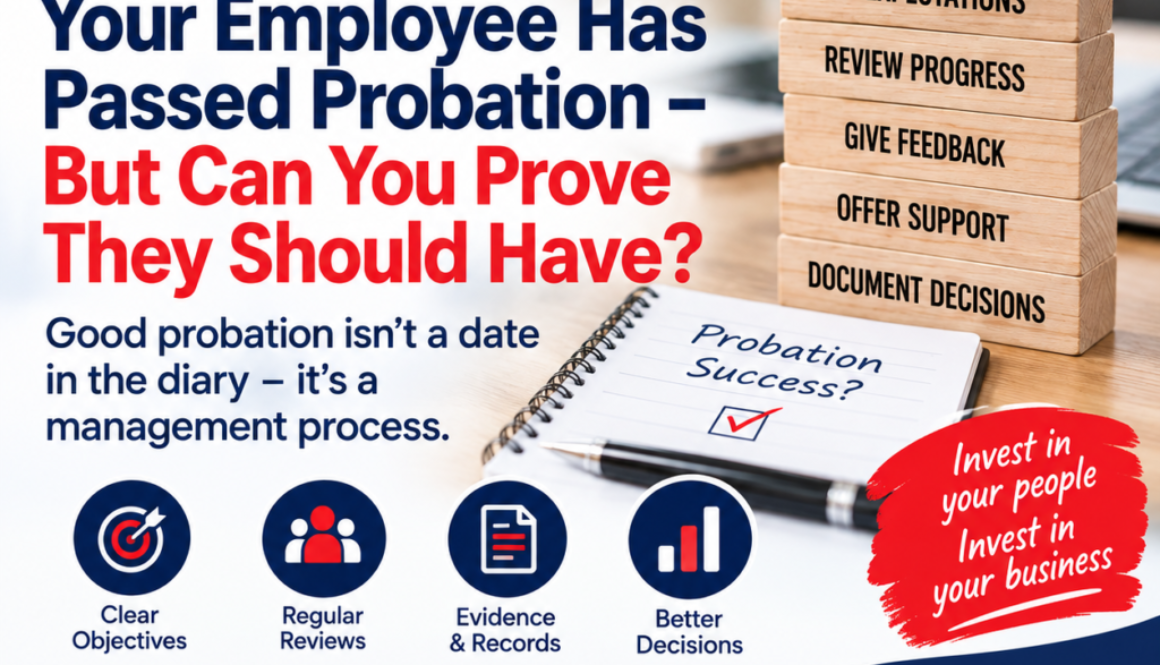
Probation is not a date in the diary – it is a management process.
“But they’re still on probation…”
Being on probation does not mean an employee has no employment rights. Employees can have important rights from the beginning of employment, including protection against discrimination and certain automatically unfair reasons for dismissal.
This is why managers should never assume: “They’re in probation, so we can just get rid of them.” There should still be a genuine business reason for the decision and an appropriate process.
What should actually happen during probation?
A well-managed probationary period should start when the employee joins the organisation – not a few days before the probation expiry date.
Expectations are clear from the beginning. The employee should understand their role, responsibilities, standards and objectives.
SMART objectives are agreed. What does successful performance actually look like, and how will it be measured?
Regular probation meetings take place. Don’t wait until the final week. Review progress throughout the probation period.
Concerns are raised when they happen. If something is not right in week four, discuss it in week four – not month six.
Support and training are provided. Employees should have a reasonable opportunity to understand and achieve the required standards.
Everything is documented. Keep notes of meetings, objectives, concerns, support and agreed actions.
A clear decision is made before probation expires. Confirm whether the employee has passed, whether an extension is appropriate where contractually permitted, or whether employment should end following an appropriate process.
ACAS guidance says that where probation is extended, the employer should tell the employee in writing before the original probation expires and agree matters such as the extension period, review points, improvement expectations, training and final review. Read more from ACAS.
The dangerous “automatic pass”
Imagine this situation. An employee has a six-month probationary period. Month one – a few concerns. Month two – the manager says performance needs to improve. Month three – another informal conversation. Month four – nothing documented. Month five – the manager is busy. Month six – the probation expiry date passes.
Two weeks later the manager contacts HR: “They’ve never really been performing. Can we extend their probation?”
That is exactly the kind of situation businesses should be avoiding. Good HR is about dealing with people issues proactively rather than reactively.
Comment from Matthew Chilcott – Owner, Consensus HR
“One of the biggest mistakes I continue to see is businesses putting a probation end date in the diary and then doing very little until that date arrives.
Throughout my career, I have always believed that probation should be an active management process. A new employee should know what is expected of them, how their performance will be measured and whether they are achieving the required standard.
If there is a problem in month one, talk about it in month one. Don’t wait until the end of probation and suddenly produce a list of concerns the employee has never previously heard.
With unfair dismissal protection changing from January 2027, getting recruitment, induction and probation right is going to become even more important.”
Matthew Chilcott – Owner, Chartered FCIPD, ACEL, BA (Hons)
Is your probation process ready for 2027?
Now is the time for employers to review:
Contracts of Employment
Probation clauses
Induction processes
Probation documentation
Manager training
SMART objectives
Performance records
At Consensus HR, we also provide our structured Probationary Period Workbook, designed to help businesses and managers properly manage and document the first months of employment.
Because the best time to discover that somebody is not right for your business is during a properly managed probation process – not months afterwards.
Need HR support?
Consensus HR provides outsourced HR & Employment Law support to businesses throughout Hertfordshire, Bedfordshire and Cambridgeshire.
Most employers can identify at least one situation where an employee’s performance, conduct or attendance has become a challenge.
What many businesses fail to recognise is the true cost of delaying action.
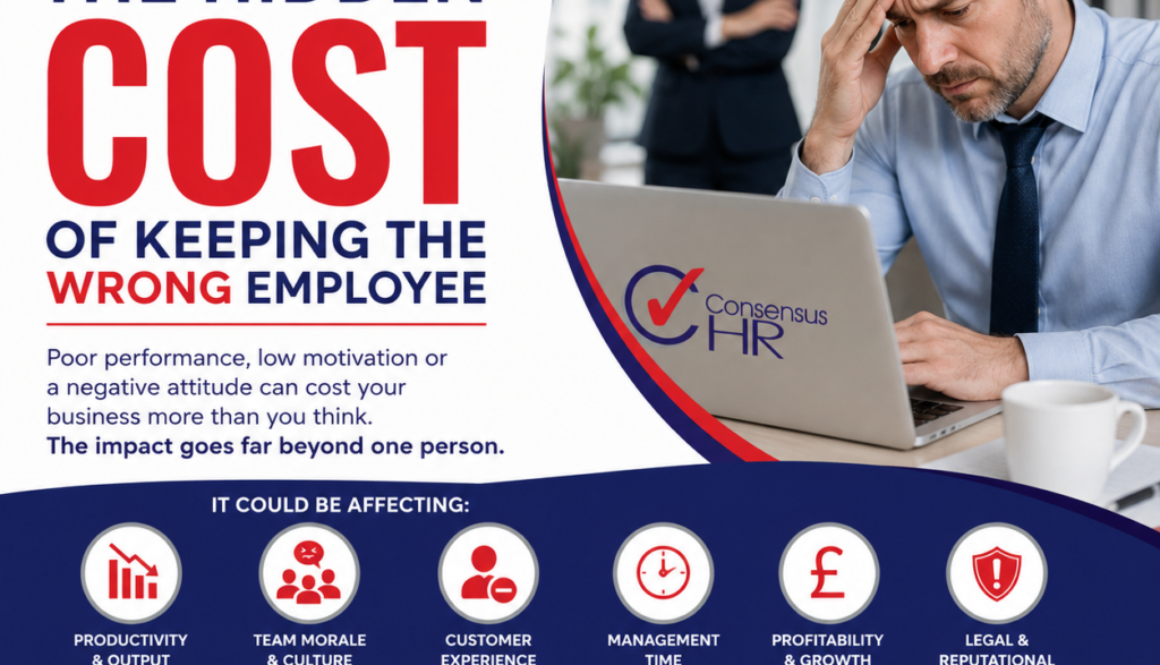
Poor performance rarely affects only one individual. It can impact:
Team morale.
Customer service.
Productivity.
Management time.
Workplace culture.
Business profitability.
Managers often avoid difficult conversations because they are worried about saying the wrong thing or creating conflict. Unfortunately, delaying action can make the situation much harder to resolve.
The most successful businesses address concerns early, communicate expectations clearly and provide appropriate support whilst maintaining accountability.
However, knowing where to start can be difficult.
Questions employers frequently ask include:
When should performance concerns be formally addressed?
What records should be kept?
How much support should be provided?
What happens if performance does not improve?
What legal risks should employers consider?
The answers will depend on the individual circumstances, but one thing remains clear: doing nothing is rarely the best option.
Comment from Matthew Chilcott – Owner, Consensus HR
“Good performance management is not about catching people out. It is about setting clear expectations, supporting employees and addressing concerns fairly and consistently. In my experience, businesses that tackle issues early achieve better outcomes for everyone involved.
Effective performance management should never be a once-a-year exercise. It is about ensuring regular, constructive feedback takes place throughout the year, whether through ongoing one-to-one meetings or structured Performance Reviews conducted at least twice a year. Employees should understand what is expected of them, receive clear SMART objectives, and be given honest, constructive feedback that helps them develop and succeed.
Open and honest conversations are not always easy, particularly when difficult messages need to be delivered. However, having the confidence and ability to hold these discussions professionally and fairly is one of the essential skills required to be a successful manager. Businesses that invest time in developing their managers and addressing concerns early are often the businesses that achieve stronger performance, greater employee engagement and better long-term results.”
Consensus HR works with employers to develop practical performance management processes, train managers and ensure that issues are handled fairly and professionally.
If you are experiencing performance concerns within your business, contact Consensus HR for confidential advice.
Helping companies take the pain out of managing people.
Matthew Chilcott FCIPD, ACEL, BA (Hons) Owner – Consensus HR
Your Outsourced Human Resources (HR) Department.
For further information on any of the HR subjects we provide, please click the heading below:
Employment law remains one of the fastest changing areas affecting UK businesses.
Many employers are aware that changes are coming, but fewer fully understand how these developments may affect their organisation, policies, contracts and management practices.
During 2026, businesses continue to monitor developments arising from the Employment Rights Act reforms, changes to employee rights and increasing expectations placed upon employers regarding workplace culture and employee wellbeing.
The real risk for employers is not necessarily the legislation itself, but failing to prepare in advance.
Questions many employers are currently asking include:
Are our contracts of employment still compliant?
Does our Employee Handbook reflect current legislation?
Are our managers trained to deal with new obligations?
Could our existing procedures expose us to unnecessary risk?
What changes should we be preparing for now?
The answers may be more complicated than many businesses realise.
Being proactive rather than reactive can often save significant time, cost and disruption later.
Comment from Matthew Chilcott – Owner, Consensus HR
Comment from Matthew Chilcott – Owner, Consensus HR
“Many business owners tell me they are aware that Employment Law changes are happening but are unsure exactly what action they need to take. This is where professional HR support can make a real difference by helping employers understand their obligations and prepare in advance.
This is one of the reasons why, as part of our monthly retained Outsourced HR & Employment Law Service, we provide ongoing Employee Handbook updates for those retained clients who have purchased their handbook through Consensus HR. When relevant Employment Law changes occur, we update their handbook as part of their monthly retained service, helping to ensure that their documentation remains current and reflects best practice.
This allows our clients to focus on what they do best – delivering their products and services to their customers – whilst having the reassurance that they can contact us whenever they need support with their team, Human Resources (HR) or Employment Law matters. By working proactively rather than reactively, businesses can often prevent people problems before they arise and reduce the risks associated with non-compliance.”
Consensus HR regularly supports organisations of all sizes with Employment Law compliance, contract reviews, handbook updates and management training.
If you are unsure whether your HR documentation and practices remain fit for purpose, now is an excellent time to arrange a free HR review.
Helping companies take the pain out of managing people.
Matthew Chilcott FCIPD, ACEL, BA (Hons) Owner – Consensus HR
Your Outsourced Human Resources (HR) Department.
For further information on any of the HR subjects we provide, please click the heading below:
Why Every Business Should Carry Out Annual Employee Handbook Reviews
Many businesses spend significant time creating an employee handbook but then fail to review it regularly.
Unfortunately, an outdated handbook can create significant risks for employers and confusion for employees.
Employment legislation, case law, and workplace expectations continue to evolve, making regular reviews essential.
What Is an Employee Handbook?
An employee handbook helps explain company rules, expectations, policies, and procedures.
It provides employees with guidance on topics such as:
Attendance.
Sickness absence.
Flexible working.
Equality and diversity.
Disciplinary procedures.
Grievance procedures.
Family-friendly rights.
Health and safety.
Data protection.
A handbook also demonstrates consistency across the organisation.
Risks of an Outdated Handbook
Problems can arise when policies no longer reflect current law or workplace practices.
Examples include:
Flexible working changes.
Family leave rights.
Sexual harassment prevention obligations.
Data protection requirements.
Remote and hybrid working arrangements.
Failure to keep policies updated can increase the risk of disputes and Employment Tribunal claims.
Benefits of Regular Reviews
An annual review allows employers to:
Ensure legal compliance.
Reflect business changes.
Improve employee understanding.
Strengthen management consistency.
Demonstrate good governance.
Regular reviews also provide an opportunity to communicate changes effectively to employees.
Don’t Forget Manager Training
Even the best policies are ineffective if managers do not understand how to apply them.
Training managers on company policies is just as important as updating the documents themselves.
Comment from Matthew Chilcott – Owner, Consensus HR
“One of the most common findings when we carry out HR audits or support new clients is discovering that their employee handbook has not been reviewed for several years. Employment law, case law, and HR best practice are constantly evolving, and employers need to ensure their policies remain relevant, practical, legally compliant, and reflective of how their business operates today.
Throughout my career in HR, from working with organisations such as Forte Hotels, Welcome Break and Veolia Water through to supporting hundreds of SMEs at Consensus HR, I have always believed that an employee handbook should be a living document. It should actively support managers and employees, provide clear guidance, and help prevent people problems before they arise. It should never be a document that sits on a shelf gathering dust.
This is one of the many benefits enjoyed by our retained clients at Consensus HR. Whenever there is a significant employment law change, update in best practice, or development that could affect their business, we review and update their handbook and policies accordingly. We then ensure our clients are informed of the changes and support them in communicating these updates to their teams, providing guidance and management development where required. By taking a proactive approach rather than a reactive one, businesses can reduce risk, maintain compliance, and create a positive workplace culture where both the organisation and its employees can thrive.“
How Consensus HR Can Help
Our retained clients benefit from ongoing handbook reviews and updates as legislation changes.
We can also assist with:
New employee handbooks.
Policy reviews.
Contract reviews.
HR compliance audits.
Manager training.
A regularly updated handbook remains one of the most effective tools available to employers.
Outsourced HR for SMEs: Why Having Expert Support Saves Time, Money and Risk
Managing people is one of the biggest challenges for any business—and one of the highest risk areas if not handled correctly.
For many SMEs, outsourcing HR is no longer a luxury—it’s a necessity.
What Is Outsourced HR?
Outsourced HR means having a professional HR partner—like Consensus HR—acting as your:
HR department
Employment law advisor
People management support
Without the cost of employing a full-time HR team.
Why SMEs Choose Outsourced HR
Businesses we support often come to us because they:
Are unsure about employment law requirements
Need support with disciplinaries, grievances, or performance issues
Want to prevent problems before they arise
Key Benefits
✔ Cost-effective – no full-time HR salary ✔ Expert advice – aligned to UK law and ACAS Code of Practice ✔ Proactive support – preventing issues, not just reacting ✔ Peace of mind – knowing you are compliant
Having expert HR support in place ensures your business is protected.
Comment from Matthew Chilcott – Owner, FCIPD, ACEL, BA(Hons)
“
“Outsourced HR is about giving business owners confidence, clarity, and peace of mind. At Consensus HR, we work as your trusted HR & Employment Law partner, helping to take the pressure away from managing people so our clients can focus on growing their business, while we ensure they remain compliant, protected, and operating to best practice.
Our proactive approach is centred on preventing people problems before they arise. We support businesses with all key HR foundations, including legally compliant Employee Handbooks, Contracts of Employment, and tailored Performance Review processes that drive performance and accountability across the team.
In addition, we deliver practical, business-focused management development and soft skills training, working with our clients step-by-step to design the right development programmes for their people.
With Consensus HR, you are not just receiving advice — you are gaining a fully outsourced HR function dedicated to supporting your business, your people, and your long-term success.”
Your Outsourced Human Resources (HR) Department.
For further information on any of the HR subjects we provide, please click the heading below:
“A positive workplace culture is not just good for people – it’s critical for business performance. Employers who ignore stress risks are exposing themselves to both legal and commercial consequences.”
🌍 Thursday Blog – Awareness Day (Christmas Edition)
Festive Wellbeing Week – Supporting Your Team This Christmas
While Christmas is a joyful season, it can also bring additional pressures — financial worries, family commitments, or feelings of loneliness. Employers can make a meaningful difference by supporting wellbeing during this period.
Ways to support your team at Christmas:
Check in regularly and encourage open communication
Offer flexibility where operationally possible
Promote wellbeing resources or Employee Assistance Programmes
Recognise hard work and celebrate achievements
Watch for signs of stress or burnout
A small gesture of support can significantly boost morale and reduce festive stress.
At Consensus HR, we help businesses develop people-focused wellbeing strategies that support teams throughout the year.
Comment from Matthew Chilcott – Owner: “Christmas affects everyone differently. A little kindness and understanding can make a big difference to your team’s wellbeing.”
🎄 Season’s Greetings from Consensus HR: We wish all our clients, partners, and community a Merry Christmas & a Happy New Year 2026! Our office will be closed 23rd December – 5th January.
HR Fact: Managing Annual Leave Carry Over – What Employers Must Know
Content: Under UK law, all employees are entitled to a minimum of 5.6 weeks’ paid annual leave per year, as outlined in the Working Time Regulations 1998.
While most employers encourage employees to use their full entitlement, there are occasions where leave can be carried over to the next holiday year. The rules depend on the reason for the carry-over:
✅ Standard holiday policy: Employers may allow limited carry-over (typically up to 1.6 weeks) by agreement. ✅ Sickness absence: Employees unable to take leave due to sickness can carry over up to four weeks for 18 months. ✅ Maternity or parental leave: Leave missed due to family-related absence can also be carried forward.
Failing to manage holiday correctly can lead to breaches of employment law and potential tribunal claims.
At Consensus HR, we help SMEs create clear, legally compliant annual leave policies that protect both the business and employees while encouraging a healthy work-life balance.
Comment from Matthew Chilcott – Owner: “Annual leave management might seem straightforward, but the rules around carry-over can catch employers out. Having the right policy in place keeps your business compliant and your team motivated.”
To view more about our range of HR & Employment Law Services
At Consensus HR, we are proud to offer a wide range of HR & Employment Law services to help our clients with all areas of best practice and Employment Law which can be found by clicking on the button:
Are you concerned about keeping your business up to date with Employment Law changes?
If your business always wishes that it works in all areas to the benefit of the team and company and as an employer of choice, give us a call or email now for a non-obligatory chat.
Consensus HR | Your Outsourced Human Resources and Employment Law Department | “Helping companies take the pain out of managing people whilst Preventing People Problems.” 01438 576750
World Values Day – 24th October 2025: Embedding Core Values into the Workplace
World Values Day (24th October 2025) celebrates the importance of living and working according to meaningful values — both personal and organisational.
For businesses, having clear company values helps drive behaviour, decision-making, and culture. Values such as integrity, collaboration, respect, and innovation not only attract the right employees but also improve retention and performance.
We use the following Values with many of our companies. CARE:
Can Do
Work as a team
Encourage others
Consistently create opportunities for improvement
Remain focussed
Accountable
Take responsibility for my job role
Make progress against objectives
Deliver on agreed actions
Evaluate impact on cost and profit
Reliable
Keep promises
Support your Team
Communicate appropriately
Maintain commitment and enthusiasm
Ethical
Deal with people respectfully
Encourage diversity
Embrace a culture of compliance
Consider the Environment
HR plays a vital role in embedding these values into everyday practice through:
Recruitment and onboarding aligned with values
Appraisal systems that measure behaviour as well as results
Training and leadership development focused on culture
Recognition programmes that reward teamwork and ethical conduct
At Consensus HR, we work with SMEs to align HR policies and leadership behaviours with company values — building teams that reflect what your business truly stands for.
Comment from Matthew Chilcott – Owner: “Values aren’t just words on a wall — they’re the foundation of successful workplaces. Embedding them through HR processes turns them into daily actions that drive business success.”
Did You Know? Employers Must Record Employees’ Working Hours
Content: Following European Court of Justice rulings (and supported by UK case law), all UK employers must keep accurate daily records of working hours — even for salaried staff — to prove compliance with the Working Time Regulations 1998.
This includes ensuring:
Staff do not work more than 48 hours per week on average (unless they’ve opted out)
Workers receive minimum daily and weekly rest periods
Accurate timesheets or system records are maintained
💡 Digital HR systems like Breathe HR, offered through Consensus HR, make this simple — allowing automatic tracking and easy reporting for compliance audits.
Comment from Matthew Chilcott – Owner: “Accurate working time records aren’t just a legal requirement — they’re a great way to improve productivity and protect your business from potential disputes.”
👉 Find out more about Breathe HR and how it supports compliance: www.consensushr.com
Content: When it comes to redundancy, many employers are unaware of their legal obligations. In the UK, employees with two years’ continuous service are entitled to Statutory Redundancy Pay.
The calculation is based on:
Age of the employee
Length of service (capped at 20 years)
Weekly pay (capped at £700 from April 2024)
Failing to follow redundancy law correctly can result in costly Employment Tribunal claims.
👉 At Consensus HR, we ensure your redundancy processes are fair, transparent, and legally compliant, protecting your business and supporting your team through difficult transitions.
Comment from Matthew Chilcott – Owner: “Redundancy can be one of the most difficult decisions for a business. Getting it wrong isn’t just financially risky, it can damage your reputation. We help SMEs manage redundancy correctly while safeguarding both business and employee interests.”
To view more about our range of HR & Employment Law Services
At Consensus HR, we are proud to offer a wide range of HR & Employment Law services to help our clients with all areas of best practice and Employment Law which can be found by clicking on the button:
Are you concerned about keeping your business up to date with Employment Law changes?
If your business always wishes that it works in all areas to the benefit of the team and company and as an employer of choice, give us a call or email now for a non-obligatory chat.
Consensus HR | Your Outsourced Human Resources and Employment Law Department | “Helping companies take the pain out of managing people whilst Preventing People Problems.” 01438 576750
We use cookies on our website to give you the most relevant experience by remembering your preferences and repeat visits. By clicking “Accept All”, you consent to the use of ALL the cookies. However, you may visit "Cookie Settings" to provide a controlled consent.
This website uses cookies to improve your experience while you navigate through the website. Out of these, the cookies that are categorized as necessary are stored on your browser as they are essential for the working of basic functionalities of the website. We also use third-party cookies that help us analyze and understand how you use this website. These cookies will be stored in your browser only with your consent. You also have the option to opt-out of these cookies. But opting out of some of these cookies may affect your browsing experience.
Necessary cookies are absolutely essential for the website to function properly. These cookies ensure basic functionalities and security features of the website, anonymously.
Cookie
Duration
Description
cookielawinfo-checkbox-analytics
11 months
This cookie is set by GDPR Cookie Consent plugin. The cookie is used to store the user consent for the cookies in the category "Analytics".
cookielawinfo-checkbox-functional
11 months
The cookie is set by GDPR cookie consent to record the user consent for the cookies in the category "Functional".
cookielawinfo-checkbox-necessary
11 months
This cookie is set by GDPR Cookie Consent plugin. The cookies is used to store the user consent for the cookies in the category "Necessary".
cookielawinfo-checkbox-others
11 months
This cookie is set by GDPR Cookie Consent plugin. The cookie is used to store the user consent for the cookies in the category "Other.
cookielawinfo-checkbox-performance
11 months
This cookie is set by GDPR Cookie Consent plugin. The cookie is used to store the user consent for the cookies in the category "Performance".
viewed_cookie_policy
11 months
The cookie is set by the GDPR Cookie Consent plugin and is used to store whether or not user has consented to the use of cookies. It does not store any personal data.
Functional cookies help to perform certain functionalities like sharing the content of the website on social media platforms, collect feedbacks, and other third-party features.
Performance cookies are used to understand and analyze the key performance indexes of the website which helps in delivering a better user experience for the visitors.
Analytical cookies are used to understand how visitors interact with the website. These cookies help provide information on metrics the number of visitors, bounce rate, traffic source, etc.
Advertisement cookies are used to provide visitors with relevant ads and marketing campaigns. These cookies track visitors across websites and collect information to provide customized ads.
Other uncategorized cookies are those that are being analyzed and have not been classified into a category as yet.
Manage Consent
To provide the best experiences, we use technologies like cookies to store and/or access device information. Consenting to these technologies will allow us to process data such as browsing behaviour or unique IDs on this site. Not consenting or withdrawing consent, may adversely affect certain features and functions.
Functional
Always active
The technical storage or access is strictly necessary for the legitimate purpose of enabling the use of a specific service explicitly requested by the subscriber or user, or for the sole purpose of carrying out the transmission of a communication over an electronic communications network.
Preferences
The technical storage or access is necessary for the legitimate purpose of storing preferences that are not requested by the subscriber or user.
Statistics
The technical storage or access that is used exclusively for statistical purposes.The technical storage or access that is used exclusively for anonymous statistical purposes. Without a subpoena, voluntary compliance on the part of your Internet Service Provider, or additional records from a third party, information stored or retrieved for this purpose alone cannot usually be used to identify you.
Marketing
The technical storage or access is required to create user profiles to send advertising, or to track the user on a website or across several websites for similar marketing purposes.