

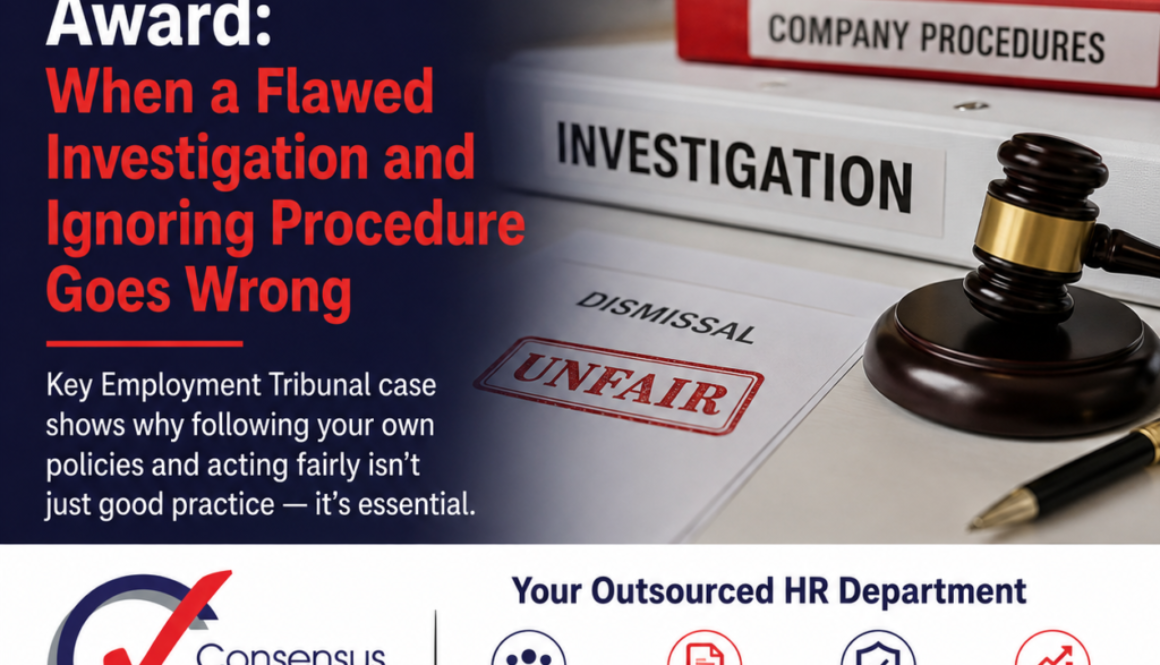
“£118,888 Unfair Dismissal Award: When a Flawed Investigation and Ignoring Procedure Goes Wrong” – Consensus HR in Herts & Beds

Employment Law Case Update | September 2026
£118,888 Unfair Dismissal Award: When a Flawed Investigation and Ignoring Procedure Goes Wrong
An employer’s failure to follow its own procedures, combined with what the Employment Tribunal found to be a deeply flawed investigation, resulted in a finding of unfair dismissal.
Award: £118,888.50The Law
Section 98 of the Employment Rights Act 1996 sets out the framework for determining whether a dismissal is fair or unfair. An employer must establish a potentially fair reason for dismissal and, under section 98(4), the tribunal then considers whether the employer acted reasonably in treating that reason as sufficient for dismissal, taking account of the circumstances, including the size and administrative resources of the employer.
In conduct cases, a fair process is also critical. ACAS guidance makes clear that investigations should be fair and objective, should gather evidence from all sides and should not be conducted simply to prove an employee’s guilt.
The Facts
The claimant had worked for the respondent for around 17 years and was an interim Joint Director of Estates and Facilities. The Employment Tribunal was told that, before the events leading to dismissal, the claimant had provided “loyal and unblemished service”.
Following a serious road traffic incident involving the claimant’s family, the claimant became the main carer for their parents and their own vehicle was written off. A replacement vehicle was ordered through the respondent’s salary sacrifice scheme, but there was a 14-month wait for delivery. During that period, the claimant used pool cars and demonstration vehicles which had been provided to the respondent free of charge by a manufacturer.
At around the same time, the respondent began a restructure. The claimant and another executive were required to re-apply for their jobs and were encouraged to consider other roles within the organisation.
In the weeks following the restructure announcement, an anonymous letter was sent to the CEO alleging that the claimant had arranged for demonstration vehicles to be obtained instead of replacing their own car. This led to an investigation and a disciplinary allegation that the claimant had used their “position, influence and office to obtain personal gain from the Trust lease car scheme and/or commercial partners”.
The disciplinary hearing resulted in dismissal for gross misconduct and the claimant brought a claim for unfair dismissal.
Employment Tribunal Decision
Important: This was an Employment Tribunal decision and is not binding authority on other tribunals. It can be persuasive and provides a useful indication of how similar procedural failings may be viewed.
1. The employer did not follow its own procedure
The claimant’s contract gave authority to dismiss to the respondent’s CEO. However, the decision to terminate employment was made by another manager. The Tribunal identified this as one of several examples of the respondent failing to follow its own procedures.
2. The investigation was not even-handed
The Tribunal found evidence of bias and concluded that the investigation had been conducted in a way that sought to validate misconduct rather than approach the matter objectively. The Tribunal also criticised the fact that the investigation had been carried out by somebody more junior than the claimant when, under the respondent’s arrangements, this should not have happened.
3. There was no evidence of dishonesty
The Tribunal found no evidence that the claimant had acted dishonestly. The claimant genuinely believed that using the demonstration vehicles was permitted and had been open and straightforward throughout the disciplinary process.
4. Senior management knew about the vehicle use
The Tribunal was satisfied that senior management were aware the claimant was using the demonstration vehicles. It also concluded that, had the claimant been told to stop, they would have done so immediately.
5. The findings did not support gross misconduct
The disciplinary panel itself found that the claimant had not sought to enrich themselves or deliberately use their position for personal gain, yet still dismissed for gross misconduct. The appeal panel then upheld the dismissal despite finding that the claimant was not guilty of gross misconduct but of serious misconduct. The Tribunal described this as the “strangest of decisions”.
6. The Tribunal considered the wider restructuring context
The Tribunal found no evidence that the claimant had used their position for personal benefit as alleged. It also considered that the respondent had already determined the claimant was surplus to requirements through the restructure and concluded that the gross misconduct allegation had effectively been used as a means of exiting the claimant from the organisation.
Taking the process as a whole, the Tribunal concluded that a reasonable employer in the circumstances would not have dismissed the claimant. The dismissal was therefore unfair and the claimant was awarded £118,888.50.
Takeaway Points for Employers
- Follow your own policies and contracts. A well-written procedure offers little protection if managers ignore it.
- Check who has authority to dismiss. Contractual and procedural authority should be confirmed before any final decision is made.
- Investigate the facts, not a preferred outcome. Evidence which supports the employee’s account must be considered just as carefully as evidence against them.
- Use an impartial and appropriately senior investigator. Consider conflicts of interest, reporting lines and organisational hierarchy.
- Make sure the allegation matches the evidence. If dishonesty or personal gain is alleged, there should be evidence capable of supporting that allegation.
- Consider consistency and proportionality. Gross misconduct should not be used as a convenient label where the facts do not justify it.
- Use the appeal properly. An appeal is an opportunity to correct an unsafe decision, not simply approve the original outcome.
- Keep restructuring and disciplinary processes genuinely separate. A conduct process should never be used as a shortcut to remove an employee because their role is no longer wanted.
Comment from Matthew Chilcott – Owner, Consensus HR
“This case is an excellent reminder that the outcome of a disciplinary process can only ever be as strong as the investigation and procedure behind it. Employers sometimes focus heavily on the allegation and not enough on whether the process is fair, objective and supported by the evidence.
At Consensus HR we regularly remind managers that an investigator’s role is not to prove that an employee is guilty. Their role is to establish the facts, consider evidence from all sides and determine whether there is a case to answer. The disciplinary manager must then make a reasonable and proportionate decision based on those facts.
When procedures are ignored, decision-makers do not have the correct authority or the evidence does not support the allegation, an employer can turn what might have been a manageable employee-relations issue into a costly Employment Tribunal claim.”
Matthew Chilcott – Owner, FCIPD, ACEL, BA (Hons)What Should Employers Do Now?
Employers should review their disciplinary and investigation procedures and make sure managers understand how to use them in practice. This includes identifying the correct investigator, setting clear terms of reference, gathering evidence from all sides, documenting findings, ensuring the employee understands the allegation and confirming who has the authority to make disciplinary and appeal decisions.
If your business is considering disciplinary action, particularly where dismissal may be an outcome, obtaining HR advice before the process begins can help ensure the procedure is fair, consistent and compliant.
Useful Guidance
- Employment Rights Act 1996 – Section 98
- ACAS – Investigations at Work
- ACAS – Disciplinary Procedure Step by Step
Need Support with a Disciplinary Investigation?
Consensus HR supports SMEs across Hertfordshire, Bedfordshire and Cambridgeshire with workplace investigations, disciplinary procedures, appeals, Employment Law and day-to-day people management.
Your Outsourced HR & Employment Law Department – helping companies take the pain out of managing people whilst preventing people problems.
Ask Consensus HR for Support View HR ServicesTelephone: 01438 576750
Email: [email protected]
Website: www.consensushr.com











Comment from Matthew Chilcott – Owner, Consensus HR
“The arrival of the Fair Work Agency is another significant change for UK employers and reinforces something we have always encouraged our clients to do – manage HR proactively rather than waiting for a problem.
An employer may believe everything is fine because nobody has complained, but an inspection does not necessarily need to follow a complaint.
If somebody arrived at your business and asked to see your employment documentation, contracts and relevant records, how quickly could you produce them and how confident would you be that everything was legally compliant and up to date?
That is the question I would encourage every SME owner and manager to ask.
Good HR is not about producing paperwork for the sake of paperwork. It is about having clear, commercial and compliant people-management processes that you can demonstrate when required.”
Matthew Chilcott – Owner, FCIPD, ACEL, BA (Hons)