|
Recruiting somebody is expensive. Recruiting the wrong person and then failing to manage their probation properly can be considerably more expensive. One of the most common situations we see when supporting businesses is an employee approaching the end of their probationary period and the manager suddenly asking: “What are we going to do about their probation?” Our response is often another question: “What have you been doing throughout their probation?” Because a probationary period should never simply be a date entered into the calendar when somebody joins the company. It should be an active management process from Day One. Why probation management is becoming even more importantFrom 1 January 2027, the qualifying period for ordinary unfair dismissal protection will reduce from the current two years to six months. The Government has specifically advised employers using contractual probation periods to consider how those arrangements will operate alongside the new six-month qualifying period. Government guidance. ACAS also emphasises that probation gives employers an opportunity to assess performance, skills and suitability while giving the employee the opportunity to decide whether the role and organisation are right for them. ACAS guidance.
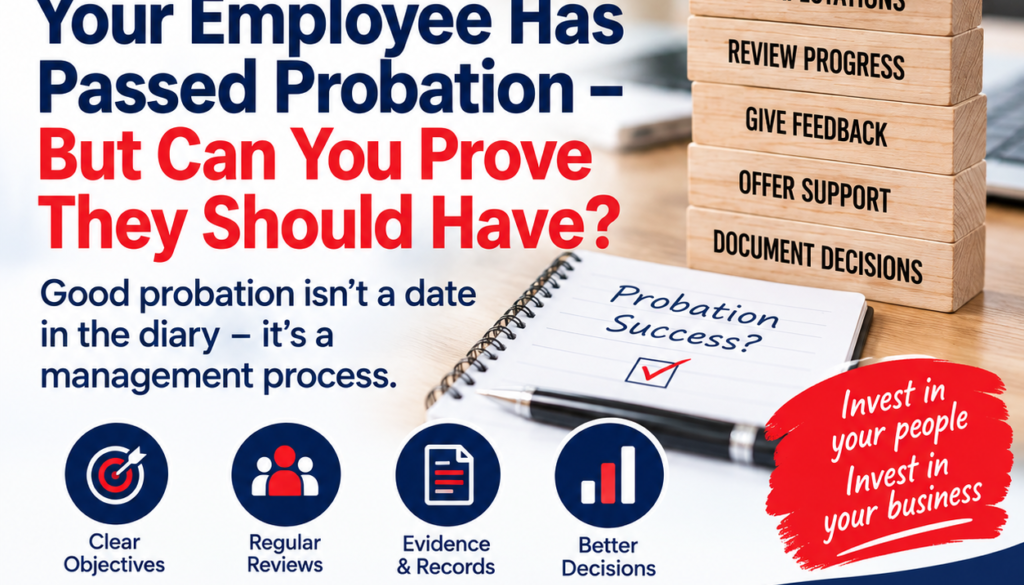
Probation is not a date in the diary – it is a management process.
“But they’re still on probation…”Being on probation does not mean an employee has no employment rights. Employees can have important rights from the beginning of employment, including protection against discrimination and certain automatically unfair reasons for dismissal. This is why managers should never assume: “They’re in probation, so we can just get rid of them.” There should still be a genuine business reason for the decision and an appropriate process. What should actually happen during probation?A well-managed probationary period should start when the employee joins the organisation – not a few days before the probation expiry date. - Expectations are clear from the beginning. The employee should understand their role, responsibilities, standards and objectives.
- SMART objectives are agreed. What does successful performance actually look like, and how will it be measured?
- Regular probation meetings take place. Don’t wait until the final week. Review progress throughout the probation period.
- Concerns are raised when they happen. If something is not right in week four, discuss it in week four – not month six.
- Support and training are provided. Employees should have a reasonable opportunity to understand and achieve the required standards.
- Everything is documented. Keep notes of meetings, objectives, concerns, support and agreed actions.
- A clear decision is made before probation expires. Confirm whether the employee has passed, whether an extension is appropriate where contractually permitted, or whether employment should end following an appropriate process.
ACAS guidance says that where probation is extended, the employer should tell the employee in writing before the original probation expires and agree matters such as the extension period, review points, improvement expectations, training and final review. Read more from ACAS. The dangerous “automatic pass”Imagine this situation. An employee has a six-month probationary period. Month one – a few concerns. Month two – the manager says performance needs to improve. Month three – another informal conversation. Month four – nothing documented. Month five – the manager is busy. Month six – the probation expiry date passes. Two weeks later the manager contacts HR: “They’ve never really been performing. Can we extend their probation?” That is exactly the kind of situation businesses should be avoiding. Good HR is about dealing with people issues proactively rather than reactively. Comment from Matthew Chilcott – Owner, Consensus HR
“One of the biggest mistakes I continue to see is businesses putting a probation end date in the diary and then doing very little until that date arrives.
Throughout my career, I have always believed that probation should be an active management process. A new employee should know what is expected of them, how their performance will be measured and whether they are achieving the required standard.
If there is a problem in month one, talk about it in month one. Don’t wait until the end of probation and suddenly produce a list of concerns the employee has never previously heard.
With unfair dismissal protection changing from January 2027, getting recruitment, induction and probation right is going to become even more important.”
Matthew Chilcott – Owner, Chartered FCIPD, ACEL, BA (Hons)
Is your probation process ready for 2027?Now is the time for employers to review: - Contracts of Employment
- Probation clauses
- Induction processes
- Probation documentation
- Manager training
- SMART objectives
- Performance records
At Consensus HR, we also provide our structured Probationary Period Workbook, designed to help businesses and managers properly manage and document the first months of employment. Because the best time to discover that somebody is not right for your business is during a properly managed probation process – not months afterwards. Need HR support?Consensus HR provides outsourced HR & Employment Law support to businesses throughout Hertfordshire, Bedfordshire and Cambridgeshire.
|