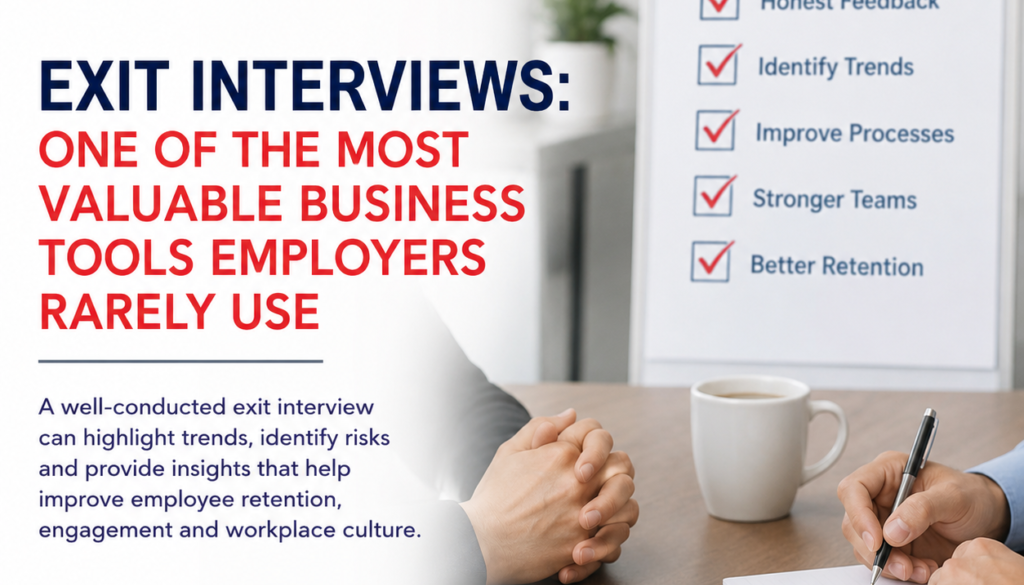
Exit Interviews: One of the Most Valuable Business Tools Employers Rarely Use
Every Resignation Provides an Opportunity to Learn
When an employee resigns, many employers focus solely on replacing them.
However, a departing employee can often provide valuable insights that help improve business performance, employee retention and workplace culture.
This is where exit interviews can become an extremely useful management tool.
Unfortunately, many organisations either fail to conduct exit interviews or treat them as a simple administrative exercise.
What Is an Exit Interview?
An exit interview is a structured discussion with an employee who has decided to leave the organisation.
The purpose is to gain honest feedback regarding their experience of working within the business.
Common topics include:
Management support
Training opportunities
Career development
Workplace culture
Communication
Employee engagement
Working conditions
Reasons for leaving
Identifying Trends
A single resignation may not reveal a problem.
However, when businesses consistently gather feedback, patterns often emerge.
Employers may identify:
High turnover in specific departments
Management issues
Training gaps
Workload concerns
Employee wellbeing challenges
Recruitment weaknesses
This information can support future business improvements.
Improving Employee Retention
Replacing employees can be expensive.
Recruitment costs, onboarding time, training and reduced productivity can all impact the business.
Understanding why employees leave can help employers make positive changes that improve retention and reduce unnecessary turnover.
Creating an Open Culture
Employees are often willing to provide constructive feedback when they know their views will be listened to professionally.
Exit interviews should never become defensive discussions.
Instead, they should focus on understanding the employee’s experience and identifying opportunities for improvement.
Making Exit Interviews Effective
To maximise value, employers should:
Use a consistent process
Ask open questions
Listen without interruption
Record themes and trends
Analyse feedback regularly
Take action where appropriate
Collecting feedback is only useful if the organisation is prepared to learn from it.
Comment from Matthew Chilcott – Owner
Comment from Matthew Chilcott – Owner
“Many employers see an employee’s resignation as the end of the process. In reality, it can provide one of the most valuable learning opportunities available. A professionally conducted exit interview can highlight trends, identify risks and provide insights that help improve employee retention, employee engagement and workplace culture.
However, employers need to understand the true value of a constructive exit interview and avoid treating it as simply another administrative exercise. The timing of the interview, the environment in which it takes place and the way questions are asked can all significantly influence the quality of information obtained.
In many cases, exit interviews become little more than a ‘happy sheet’, with the departing employee telling their employer what they believe management wants to hear. They may state that everything was fine, that they are leaving purely for career progression or financial reasons, and that their departure has nothing to do with the business, their manager or the team they have been working with. Whilst this may genuinely be the case, employers should recognise that some employees may not feel comfortable providing honest feedback during a formal meeting immediately before they leave.
Equally, business owners and managers must be prepared to receive constructive criticism professionally. If several employees identify similar concerns regarding management practices, communication, training, workload, systems or workplace culture, this feedback should not be dismissed simply because it is uncomfortable to hear. Instead, it should be reviewed objectively and, where appropriate, investigated further.
That does not mean every comment should automatically be accepted as fact. Employers should consider the context of the feedback, look for recurring themes and carry out appropriate investigations before making changes. Occasionally, feedback may simply reflect the views of an individual who is unhappy about leaving or who wishes to air grievances on departure. However, where patterns emerge across multiple exit interviews, businesses should view this as valuable management information.
The most effective organisations use exit interviews as part of a wider employee engagement and continuous improvement strategy. They listen, analyse trends, investigate where necessary and take action when improvements can be made. Done correctly, an exit interview can provide insights that help strengthen employee retention, management effectiveness, workplace culture and overall business performance.”
How Consensus HR Can Help
Consensus HR assists businesses with employee retention strategies, employee engagement programmes, management development, workplace culture reviews and HR best practice.
Helping companies take the pain out of managing people whilst building stronger and more successful teams.
Your Outsourced Human Resources (HR) Department.
For further information on any of the HR subjects we provide, please click the heading below: