Why Your Employee Handbook Could Soon Become Your Most Important Business Document | Herts & Beds
Many employers see their Employee Handbook as something produced when the business starts and then forgotten about.
Unfortunately, that approach could become both costly and risky.
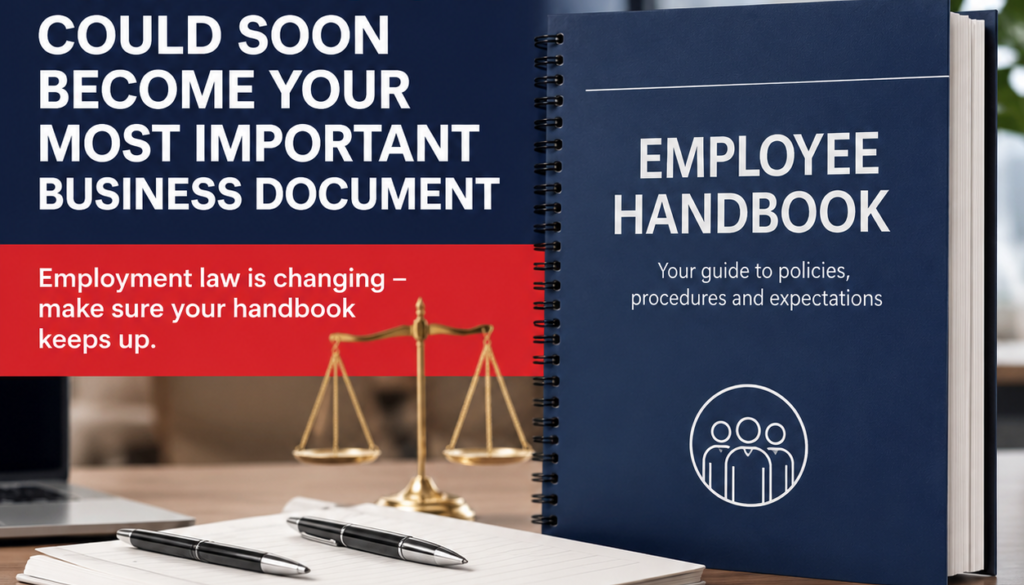
With significant Employment Law changes continuing throughout 2026 and further major reforms taking effect from 1 January 2027, businesses need to ensure that their policies remain legally compliant and reflect current best practice.
An Employee Handbook should never simply sit on a shelf gathering dust.
It should be a living document that evolves alongside your business.
Why does it matter?
Your handbook provides clear guidance for employees on matters such as:
- Sickness absence
- Holiday entitlement
- Flexible working
- Social media
- Equality & Diversity
- Grievance procedures
- Disciplinary rules
- Performance management
- Family friendly leave
- Standards of behaviour
When policies are outdated, managers often make inconsistent decisions.
Those inconsistencies frequently become the evidence relied upon during Employment Tribunal proceedings.
Employment Law continues to evolve
Recent and forthcoming changes include:
- New unfair dismissal qualifying periods
- Family leave reforms
- Greater emphasis on probationary management
- Increased expectations around workplace wellbeing
- Continuing duties relating to preventing workplace harassment
Businesses need documentation that reflects today’s legislation—not guidance written several years ago.
It also protects managers
A good handbook doesn’t just tell employees what is expected.
It provides managers with confidence.
When difficult situations arise, they have documented procedures to follow rather than making decisions on instinct.
That consistency helps businesses remain fair, transparent and legally compliant.
Matthew Chilcott’s Comment
“One of the biggest mistakes I see is businesses assuming their Employee Handbook only needs updating every few years. Employment Law changes continuously, and your documentation should evolve alongside it. At Consensus HR, retained clients who have purchased their Employee Handbook through us receive updated versions whenever legislation changes, together with training notes to help managers and employees understand exactly what has changed and what it means in practice.
Over the years, we’ve written many articles about the importance of having a well-written, user-friendly Employee Handbook, but just as importantly, one that is fully transparent and easily accessible to every member of the team. Whether that’s available through Breathe HR, kept as a printed copy within the workplace or provided as part of every employee’s induction, there should never be any doubt about where employees can find it or what standards and procedures the business expects everyone to follow.
One of the comments I hear time and time again is, ‘Our handbook is too big—nobody reads it.’ My response is always the same: do you, as a business, actually use it? Is it something that managers refer to regularly, discuss during inductions, use in one-to-one meetings, performance reviews and return-to-work interviews? Or does it only come off the shelf when a disciplinary, grievance or Employment Tribunal claim arises?
An Employee Handbook should never be a document written simply to satisfy legal requirements or left gathering dust in a drawer. It should become part of the culture of the organisation. Managers should know it, understand it and consistently apply the policies and standards it contains. Employees should be encouraged to refer to it throughout their employment, not just on their first day. If everyone understands the rules, expectations and benefits from the outset, misunderstandings are reduced, consistency improves and many workplace issues can be prevented before they ever develop.
Throughout my career, I’ve always believed that an Employee Handbook should become a business’s ‘bible’ when it comes to managing people. It provides the framework for fairness, consistency and transparency, helping managers make confident decisions while ensuring employees understand what is expected of them. Like any successful business process, however, it only delivers value if it is actively used, regularly reviewed and kept up to date. Employment Law will continue to change, your business will continue to evolve, and your handbook should evolve with it. A handbook that is regularly referred to, understood and embedded into everyday management is one of the most valuable tools any employer can have.”
Matthew Chilcott
Owner – Consensus HR
Chartered FCIPD | ACEL | BA (Hons)
Is your handbook still fit for purpose?
If you’re unsure when it was last reviewed, now is the perfect opportunity to carry out an HR Health Check.
A small investment today could prevent significant problems tomorrow.
Contact Consensus HR today
📞 01438 576750
Follow Consensus HR:
LinkedIn: https://www.linkedin.com/company/consensushr
Facebook: https://www.facebook.com/ConsensusHR
Instagram: https://www.instagram.com/consensushr
Your Outsourced Human Resources (HR) Department.
For further information on any of the HR subjects we provide, please click the heading below: