Monthly HR blog Newsletter – December 2025 | Consensus HR, Herts, Beds

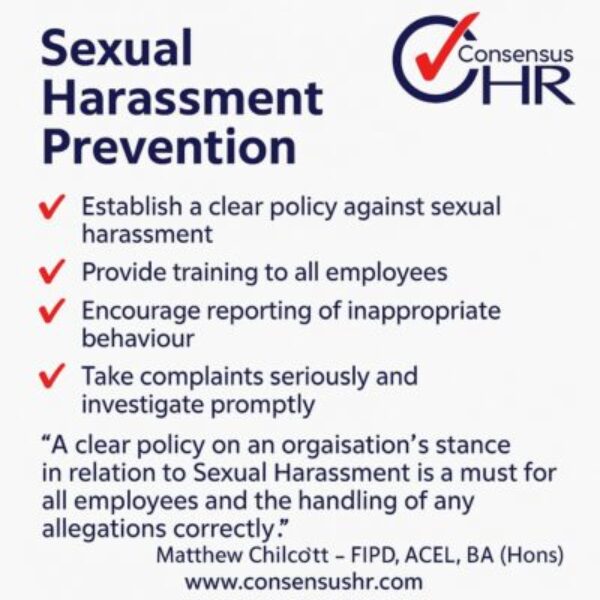
Tackling Sexual Harassment at Work: Why Proactive Action Protects Your Business | Consensus HR
exual harassment is unlawful — and from 26 October 2024, every UK employer also has a proactive legal duty to prevent sexual harassment under the Equality Act 2010, in addition to existing responsibilities under the Health & Safety at Work Act 1974.
This means employers must take reasonable steps to stop harassment before it happens, not just react afterwards. Failure to do so places businesses at risk of tribunal claims, compensation uplifts of up to 25%, and possible enforcement action by the Equality & Human Rights Commission (EHRC).
At Consensus HR, we work with SMEs to ensure their business, their people, and their reputation are always protected.
Learn more at: https://www.consensushr.comThe Business Advantages of Taking Action
Employers who address sexual harassment proactively benefit from:
Greater employee morale and confidence
Increased engagement and trust
Better employee relations
Higher productivity and fewer absences
Reduced risk of tribunal claims
Reduced risk of EHRC enforcement action
A stronger, safer workplace culture
Preventing harassment is not only a legal requirement — it is a strategic advantage for every business.
To read our article in full,
📰 HR Update – Keep Britain Working: Tackling Ill-Health and Disability in the Workplace:
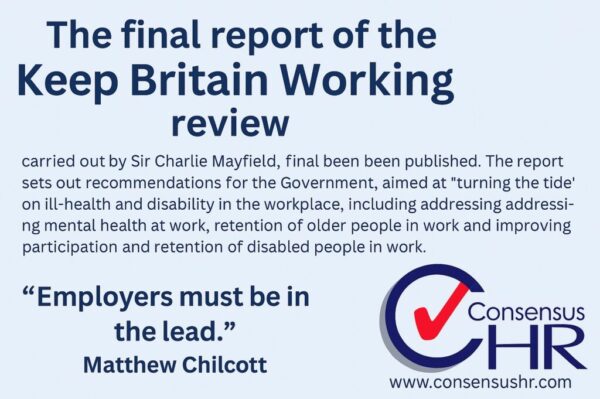
The Keep Britain Working Review – Final Report Released
The final report of the Keep Britain Working review, led by Sir Charlie Mayfield, has now been published, calling for urgent action to address what he describes as a “quiet but urgent crisis” in the UK labour market.
Over one in five working-age adults are currently out of the workforce — a figure driven largely by ill-health and disability. The report calls for a “new deal” between employers, employees and Government, with employers taking a leading role in improving workplace health and retention.
“Employers will need to do more,” Mayfield says, as they are “uniquely placed to act on prevention, to support rehabilitation, and to remove barriers for disabled people.”
The Cost of Ill-Health to UK Businesses
According to the report, UK employers lose an average of £120 per day in profit for every sickness absence, with total costs estimated at £85 billion a year in lost output and ill-health-related expenses.
With 150 million working days lost annually, businesses face significant disruption, reduced capacity, and higher unplanned costs — highlighting the urgent need for proactive HR and wellbeing strategies.
At Consensus HR, we support employers across all sectors to manage sickness absence fairly and effectively, while ensuring legal compliance under the Equality Act 2010 and promoting a culture of prevention and support.
To read our latest post in full:

⚖️ School Ordered to Pay £137,000 for Failing to Make Reasonable Adjustments | Consensus HR – Herts & Beds:
A recent Employment Tribunal has awarded a teacher £137,000 in compensation after her school failed to make reasonable adjustments for her disability.
The tribunal heard that the teacher suffered from depression and anxiety, which affected her ability to attend work. Rather than offering support or adjustments, the school chose to discipline her for absence and performance issues, ultimately leading to her resignation.
The Tribunal found that the school had breached its duty under the Equality Act 2010 to make reasonable adjustments once it became aware — or should have been aware — of her condition.
💭 Mental Health and Disability Discrimination
This case highlights an important reminder for all employers:
Disability discrimination is not limited to physical impairments.Under the Equality Act 2010, a disability is defined as a physical or mental impairment that has a substantial and long-term adverse effect on a person’s ability to carry out normal day-to-day activities.
Conditions such as depression, anxiety, or stress-related illnesses can therefore meet this definition, depending on the impact on the individual.A key principle that often catches employers out is the “ought to have known” test. In Gallop v Newport City Council, the Court of Appeal made clear that an employer cannot rely solely on an occupational health report stating that an employee is not disabled if other evidence indicates otherwise.
To read our article in full,
📘 HR Fact: Understanding Maternity Leave and Pay – What Employers Must Provide:
UK employees are entitled to up to 52 weeks of maternity leave, which is divided into Ordinary Maternity Leave (26 weeks) and Additional Maternity Leave (26 weeks).
Eligible employees may also receive Statutory Maternity Pay (SMP) for up to 39 weeks, though eligibility depends on pay, service length, and correct notice being given.
Employers must ensure they understand both legal entitlements and record-keeping requirements — mistakes here can lead to costly tribunal claims.
At Consensus HR, we help employers implement fair, compliant maternity procedures and ensure policies reflect the latest UK legislation.
Comment from Matthew Chilcott – Owner:
“Maternity rights are complex and ever-changing. Having accurate advice and compliant policies in place protects your business and your people.”
👉 Contact Consensus HR for expert maternity and family leave support: www.consensushr.com
To read our latest post in full:
Did You Know? UK Employers Must Carry Out Right to Work Checks Before Employment Begins:
Every employer in the UK must carry out Right to Work checks before a new employee starts work. These checks confirm that an individual has valid permission to work in the UK.
Documents such as passports, visas, or share codes (for online checks) must be verified and securely recorded before employment starts.
Failure to complete these checks correctly can lead to penalties of up to £60,000 per illegal worker and potential criminal prosecution.
At Consensus HR, we help businesses ensure their onboarding and compliance processes meet UK immigration law and employment standards.
Comment from Matthew Chilcott – Owner:
“Right to Work checks are essential for every business — one mistake can be extremely costly. We make compliance easy, practical, and secure.”
👉 Find out how Consensus HR can help you stay compliant: www.consensushr.comTo read our article in full,
📘 HR Fact: Understanding Redundancy Consultation Requirements:
Redundancy can be one of the most difficult situations a business faces. However, it must always be handled fairly, legally, and with proper consultation.
If you’re considering making redundancies, UK law requires employers to:
Consult with affected employees before any final decisions are made.
Provide a clear business reason for the redundancy.
Follow fair selection and notice procedures.
Where 20 or more employees may be affected within a 90-day period, collective consultation rules apply. Failure to follow them can result in protective awards of up to 90 days’ pay per employee.
At Consensus HR, we guide SMEs through every step of the redundancy process — ensuring compliance, fairness, and business continuity.
Comment from Matthew Chilcott – Owner:
“Redundancy is never easy, but handled correctly it protects both your people and your reputation. We make sure employers follow the law while treating staff with respect.”
👉 Find out how we can help your business manage redundancy fairly: www.consensushr.com
📲 Follow Consensus HR:
To read our latest post in full:
To view more about our range of HR & Employment Law Services
Are you concerned about keeping your business up to date with Employment Law changes?
Your Outsourced Human Resources (HR) Department.
For further information on any of the HR subjects we provide, please click the heading below: