The Cost of Poor Management Training: Why Technical Experts Do Not Always Make Great Managers
Promoting the Best Employee Is Not Always the Best Management Decision
One of the most common mistakes businesses make is assuming that because somebody excels in their current role, they will automatically become an effective manager.
Many organisations identify their highest-performing employee, reward them with a promotion and then expect them to lead a team successfully without providing the skills, knowledge or support required to manage people.
Unfortunately, technical competence and people management are two very different skill sets.
Whilst promotion can be an excellent way to recognise talent and retain valuable employees, businesses must ensure they invest in management development if they want newly promoted managers to succeed.
The Reality of “Key Syndrome”
It reminds me of my own operational management days within the hospitality sector, where I often referred to this as “Key Syndrome”.
Any member of the team who was never sick, always turned up on time, worked hard and demonstrated reliability would often be handed a set of keys and expected to manage a team and a high-footfall, high-turnover business. In many cases, there was little structured development and it became a case of sink or swim.
Fortunately, I swam.
Growing up, I was heavily influenced by my mother, who successfully ran a number of businesses throughout my youth. Watching her lead people, make decisions and overcome challenges provided me with many of the management skills that I later developed throughout my career.
However, not everybody has that advantage.
Management Requires Different Skills
Managing people involves much more than understanding the operational side of a business.
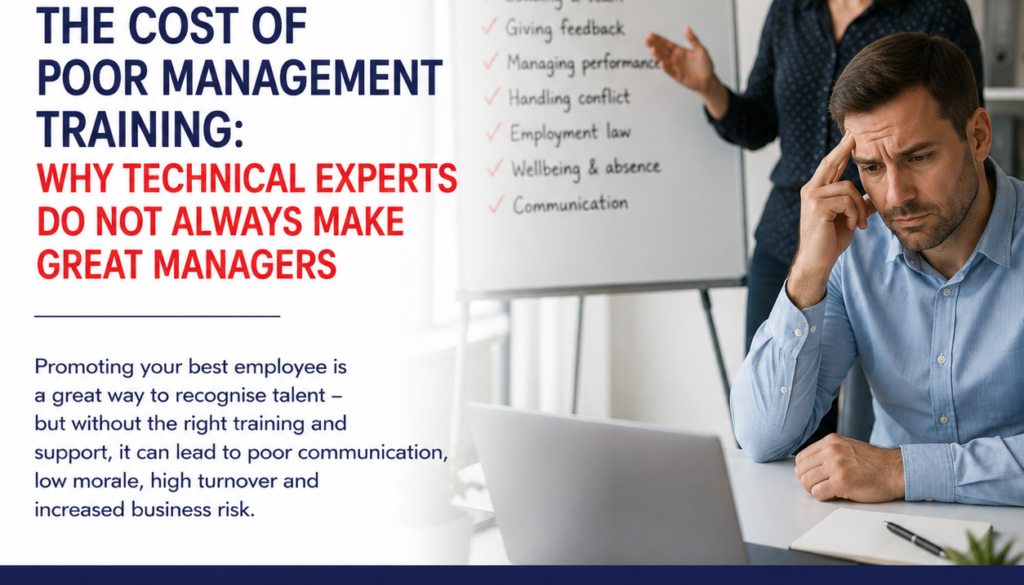
Managers are expected to:
-
Conduct difficult conversations
-
Manage performance
-
Handle sickness absence
-
Support employee wellbeing
-
Deal with conflict
-
Recruit and onboard new employees
-
Deliver feedback effectively
-
Maintain morale and engagement
-
Understand Employment Law responsibilities
Without support and development, many new managers can quickly become overwhelmed.
The Risks of Poor Management Development
Poorly trained managers can unintentionally create significant business risks.
Common consequences include:
-
Increased employee turnover
-
Higher sickness absence levels
-
Poor employee engagement
-
Workplace conflict
-
Inconsistent management decisions
-
Increased grievances
-
Potential Employment Tribunal claims
In many cases, the issue is not the manager themselves but the lack of training and support they received when promoted.
Development Does Not Need To Be Expensive
Management development does not always require expensive external courses.
Some of the most effective learning can be achieved through:
-
Mentoring
-
Coaching
-
Job shadowing
-
Structured one-to-one meetings
-
Internal development programmes
-
Management workshops
-
Peer support networks
Practical, real-world learning often delivers excellent results.
Part of the Employee Lifecycle
Developing managers should form part of the wider Employee Lifecycle.
From recruitment and onboarding through to succession planning and career development, businesses should continuously identify and nurture future leaders.
Investing in people development not only improves performance but also strengthens employee retention and workplace culture.
Comment from Matthew Chilcott – Owner
“Throughout my career, I have seen many businesses promote their best operational employee into a management role without providing any management training. Whilst technically excellent, they are often expected to suddenly manage performance, wellbeing, absence, recruitment and difficult conversations without the necessary support or development. Businesses need to ensure that employees are given the skills, knowledge and confidence required to fulfil their roles successfully. Organisations that invest in developing their managers are often the organisations that build stronger teams, achieve better performance and create more positive workplace cultures.
Many companies genuinely believe they are rewarding and supporting a reliable employee when they offer them a promotion into management. The individual may have an excellent attendance record, consistently perform well and be viewed as a valuable member of the team. However, failing to provide the necessary management skills and tools can have the opposite effect.
Without appropriate support, that key employee can quickly become demotivated, stressed and overwhelmed by the expectations placed upon them. They may begin to struggle with managing people, handling difficult situations and balancing operational responsibilities with management duties. Over time, this can affect both their wellbeing and performance, potentially leading to sickness absence, loss of confidence and a situation where they begin to resent the role they once aspired to achieve.
I have seen individuals reach a stage where they openly admit that management was not what they expected. They find themselves carrying significantly more responsibility, dealing with challenging employee issues and working longer hours, yet often feeling there is little reward for the additional pressure they are experiencing. In many cases, the issue is not the individual; it is the lack of development and support they received following promotion.
Businesses should therefore view management development as an ongoing investment rather than a one-off event. New and existing managers should be continually provided with opportunities to develop their skills, knowledge and confidence. This may involve external management development programmes, internal workshops, coaching, mentoring or simply spending time learning from experienced managers within the organisation.
Effective management development does not have to cost a fortune, but it does need to be planned, structured and supported. The most successful organisations work with their managers to identify development needs, create realistic development plans and ensure individuals play an active role in their own learning and progression. When businesses invest in their managers, everybody benefits — the individual, the team and ultimately the organisation as a whole.”
How Consensus HR Can Help
Consensus HR provides practical management development programmes, leadership training, HR support and Employment Law guidance to help businesses develop confident and effective managers.
Helping companies take the pain out of managing people.
Your Outsourced Human Resources (HR) Department.
For further information on any of the HR subjects we provide, please click the heading below: