
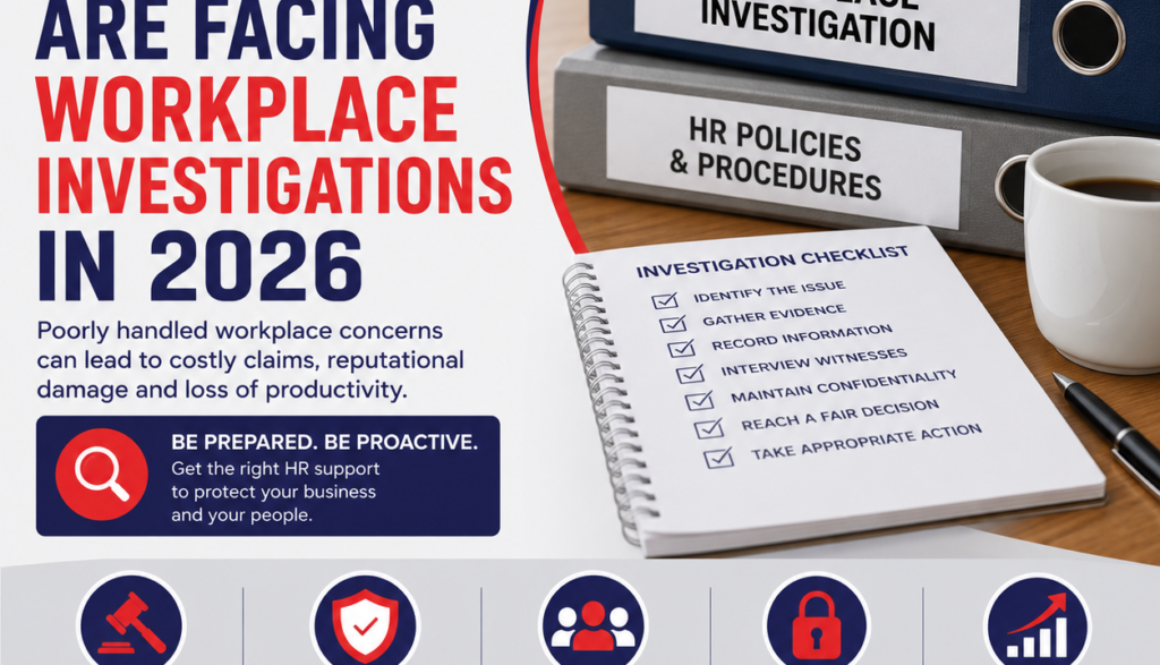
Why More UK Employers Are Facing Workplace Investigations in 2026
Many employers believe that workplace investigations are only required for serious disciplinary matters. In reality, investigations form the foundation of many HR processes including grievances, bullying allegations, harassment complaints, absence concerns, misconduct cases and performance management issues.
Throughout 2026, employers continue to face increasing scrutiny over how workplace concerns are handled. A poorly managed investigation can quickly escalate into an Employment Tribunal claim, reputational damage, reduced employee engagement and significant management time being diverted away from running the business.
One of the most common mistakes employers make is rushing to a conclusion before gathering all the facts. Another is failing to keep appropriate records or ensure a fair and impartial process.
Recent Employment Tribunal decisions continue to demonstrate the importance of following fair procedures and acting reasonably throughout any workplace investigation.
The challenge for many businesses is knowing:
-
When an investigation is actually required.
-
Who should carry out the investigation.
-
What questions should be asked.
-
How evidence should be gathered.
-
What documentation should be retained.
-
When external HR support may be required.
Getting these steps wrong can have costly consequences.
Comment from Matthew Chilcott – Owner, Consensus HR
“Throughout my HR career, I have seen many situations where the issue itself was relatively straightforward, but poor handling of the investigation created much bigger problems. A well-managed investigation helps employers make informed decisions whilst demonstrating fairness, consistency and professionalism.
Too often, managers and business owners either do not carry out a thorough enough investigation or fail to ask the right questions of the right people. An investigation should never be viewed as a simple conversation or fact-finding exercise. It forms a crucial part of any subsequent decision-making process and, if challenged, may be scrutinised by an Employment Tribunal.
At Consensus HR, we have found that we are increasingly advising clients on the importance of properly documenting investigations and, where appropriate, recording meetings. However, before any recording takes place, employers must ensure the correct procedures are followed, including obtaining consent, explaining the purpose of the recording and ensuring employees understand their rights and how the information will be used.
There are many factors that employers need to consider. Who should be present at the meeting and what are their respective roles? Can the employee be accompanied? Will they receive copies of the notes or recording afterwards? What information should they receive before the meeting? What outcomes may arise from the investigation? What records should be retained and for how long? Who ultimately makes the decision based upon the evidence gathered? Is it management, HR, or both? Even practical considerations such as where the meeting should be held and ensuring confidentiality can have a significant impact on the process.
These are just a few of the many issues that need to be considered when dealing with Employment Law matters. A thorough, fair and well-documented investigation not only helps employers reach the right decision but also demonstrates that they have acted reasonably, fairly and in accordance with best practice should their actions ever be challenged.”
At Consensus HR, we support businesses with workplace investigations, disciplinary matters, grievance procedures and employee relations issues. Our retained clients receive ongoing advice and support to help manage these situations correctly from the outset.
If you are currently dealing with a workplace concern and would like professional guidance, contact Consensus HR today.
Helping companies take the pain out of managing people.
Matthew Chilcott FCIPD, ACEL, BA (Hons)
Owner – Consensus HR
Your Outsourced Human Resources (HR) Department.
For further information on any of the HR subjects we provide, please click the heading below: